
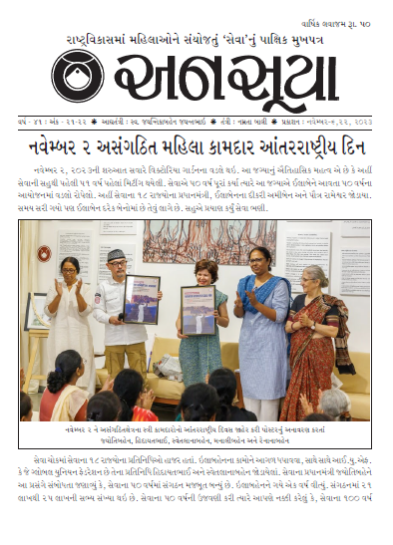


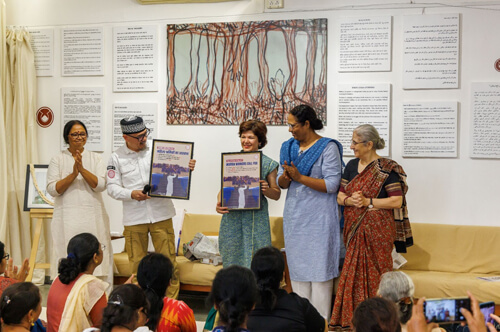
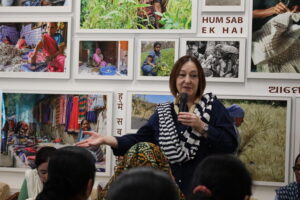
 Declaration of November 2nd as International Day for achieving voice, visibility, validation of women workers in the informal sector in honour of Elaben. Poster release declaring November 2 an International Day for achieving voice, visibility, validation of women workers in the informal sector in honour of Elaben. (left to right) Jyoti Macwan, Hidayat Greenfield, Svetlana Boincean, Manali Shah, Renana Jhabvala.
In a befitting tribute to the relentless work of SEWA's founder Elaben Bhatt to organise and empower women working in the informal sector, the IUF – International Union of Food, Agricultural, Hotel, Restaurant, Catering, Tobacco, and Allied Workers' Associations – on Thursday announced celebrating November 2 as the International Day for Unorganized Women Workers. Elaben passed away on November 2, 2022.
The announcement, which is a major endorsement of Elaben’s life and work dedicated to women in the unorganised sector, was made at the SEWA Reception Centre where Hidayat Greenfield, Regional Secretary of IUF for Asia Pacific and Svetlana Boincean, International Officer for Agriculture and Plantation at IUF, joined SEWA’s Jyoti Macwan, Manali Shah and Renana Jhabvala along with SEWA sisters from all states.
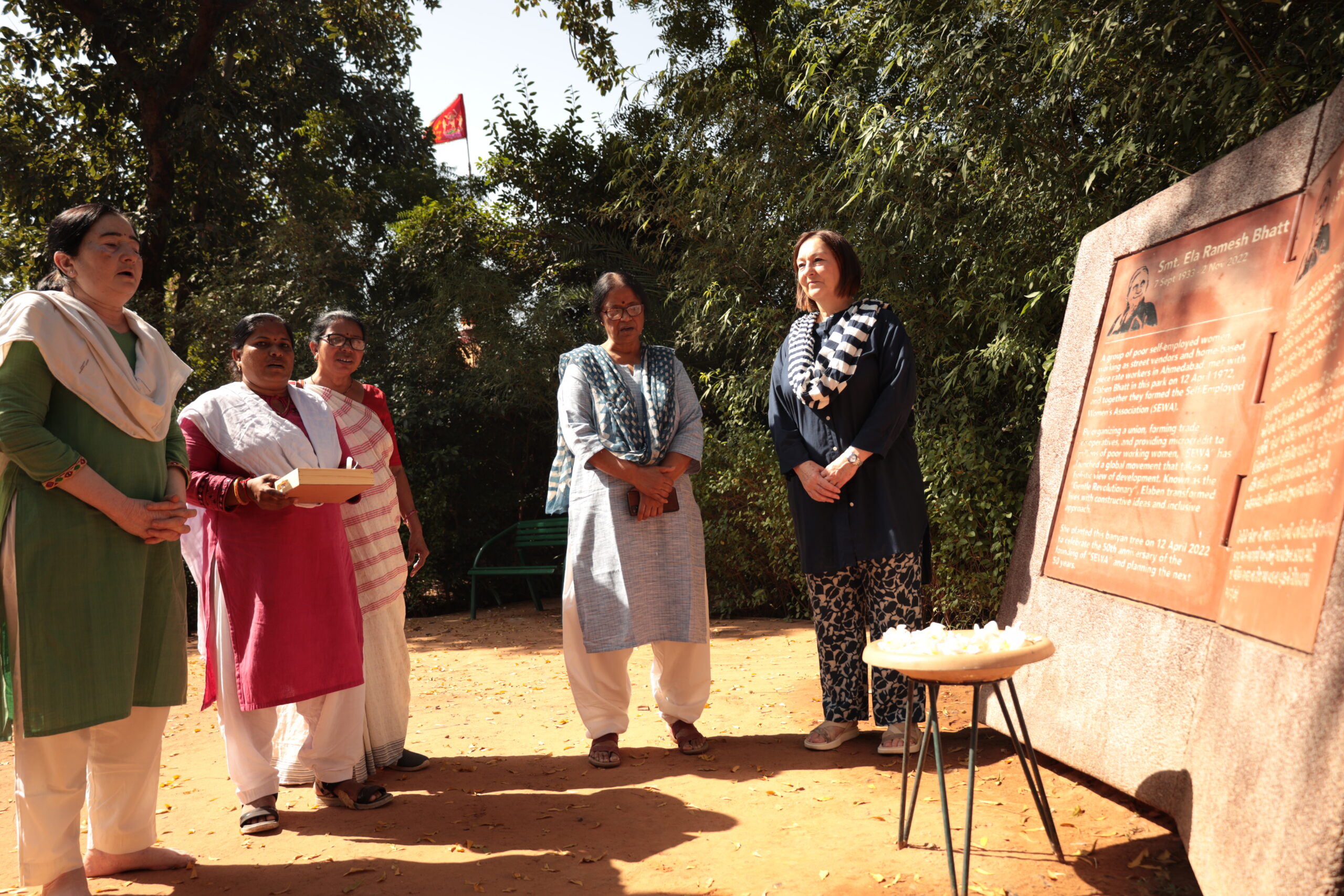
Jyoti Macwan, General Secretary of SEWA, said that the membership of SEWA has increased from 21 lakh to 29 lakh, and the organization is ever-expanding. “This was the place where Elaben carried out knowledge sharing sessions ‘Baudhik Shala’ for 30 months. Here she taught us how to think. If I just make a list of the topics she covered, it would be humongous from religion to environment and society to leadership. Two things that stayed with me from all the interactions was the message of truth and simplicity,” she said. The members of SEWA responded with a resounding yes when Macwan said that they would be celebrating 100 years of SEWA, too.
SEWA, founded in 1972, completed 50 years in 2022. Manali Shah, National Secretary of SEWA, in her speech, said that creative and enthusiastic women workers have the potential to bring justice in the world through their work. As the event saw the unveiling of ‘Bolti Bheent’ or ‘Speaking Walls,’ Shah gave context to it, saying that the exercise is to give visibility to largely invisible women workers. “The three ethos of voice, visibility and validity are fulfilled by this wall. I remember that when we were discussing hanging the pictures on the wall, Elaben had said that it is not a museum, and the wall should be full of pictures which are of the women who are still working,” said Shah.
“Work is an important part of their lives and identity as women, they are still not getting the due credit from their employers, middlemen or contractors nor from their family members. What Elaben calls Anubandh is a bond of interconnectedness.”
Declaration of November 2nd as International Day for achieving voice, visibility, validation of women workers in the informal sector in honour of Elaben. Poster release declaring November 2 an International Day for achieving voice, visibility, validation of women workers in the informal sector in honour of Elaben. (left to right) Jyoti Macwan, Hidayat Greenfield, Svetlana Boincean, Manali Shah, Renana Jhabvala.
In a befitting tribute to the relentless work of SEWA's founder Elaben Bhatt to organise and empower women working in the informal sector, the IUF – International Union of Food, Agricultural, Hotel, Restaurant, Catering, Tobacco, and Allied Workers' Associations – on Thursday announced celebrating November 2 as the International Day for Unorganized Women Workers. Elaben passed away on November 2, 2022.
The announcement, which is a major endorsement of Elaben’s life and work dedicated to women in the unorganised sector, was made at the SEWA Reception Centre where Hidayat Greenfield, Regional Secretary of IUF for Asia Pacific and Svetlana Boincean, International Officer for Agriculture and Plantation at IUF, joined SEWA’s Jyoti Macwan, Manali Shah and Renana Jhabvala along with SEWA sisters from all states.
Jyoti Macwan, General Secretary of SEWA, said that the membership of SEWA has increased from 21 lakh to 29 lakh, and the organization is ever-expanding. “This was the place where Elaben carried out knowledge sharing sessions ‘Baudhik Shala’ for 30 months. Here she taught us how to think. If I just make a list of the topics she covered, it would be humongous from religion to environment and society to leadership. Two things that stayed with me from all the interactions was the message of truth and simplicity,” she said. The members of SEWA responded with a resounding yes when Macwan said that they would be celebrating 100 years of SEWA, too.
SEWA, founded in 1972, completed 50 years in 2022. Manali Shah, National Secretary of SEWA, in her speech, said that creative and enthusiastic women workers have the potential to bring justice in the world through their work. As the event saw the unveiling of ‘Bolti Bheent’ or ‘Speaking Walls,’ Shah gave context to it, saying that the exercise is to give visibility to largely invisible women workers. “The three ethos of voice, visibility and validity are fulfilled by this wall. I remember that when we were discussing hanging the pictures on the wall, Elaben had said that it is not a museum, and the wall should be full of pictures which are of the women who are still working,” said Shah.
“Work is an important part of their lives and identity as women, they are still not getting the due credit from their employers, middlemen or contractors nor from their family members. What Elaben calls Anubandh is a bond of interconnectedness.”
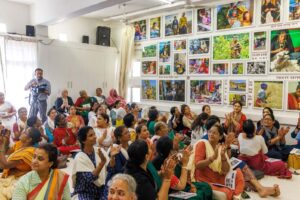 She added that the wall from its concept to execution has taken more than two years. Apart from 70 pictures, the wall also has SEWA manifesto in different languages, and a picture of the banyan tree – a homage to the first meeting place for Elaben in Victoria Garden.
Renana Jhabvala, a long-term associate of Elaben, gave a perspective on the SEWA Reception Centre, saying that when Elaben did not have a permanent place to meet the worker women, she had come in contact with Mr. Charles Ford, General Secretary, International Textile, Garment and Leather Workers' Federation (1971 to 1988). When she explained the need for a place for women, he exclaimed, "Oh, you want a Reception Centre." The name remained stuck, she said. She also remembered Elaben’s travels across the country and her transforming journey for taking SEWA to other parts of India. “As we are here, Elaben is also here in our hearts and minds. The members are taking forward her dream and vision for women of India as SEWA is a proud member of IUF and organizations such as ITGLWF,” she said.
She added that the wall from its concept to execution has taken more than two years. Apart from 70 pictures, the wall also has SEWA manifesto in different languages, and a picture of the banyan tree – a homage to the first meeting place for Elaben in Victoria Garden.
Renana Jhabvala, a long-term associate of Elaben, gave a perspective on the SEWA Reception Centre, saying that when Elaben did not have a permanent place to meet the worker women, she had come in contact with Mr. Charles Ford, General Secretary, International Textile, Garment and Leather Workers' Federation (1971 to 1988). When she explained the need for a place for women, he exclaimed, "Oh, you want a Reception Centre." The name remained stuck, she said. She also remembered Elaben’s travels across the country and her transforming journey for taking SEWA to other parts of India. “As we are here, Elaben is also here in our hearts and minds. The members are taking forward her dream and vision for women of India as SEWA is a proud member of IUF and organizations such as ITGLWF,” she said.
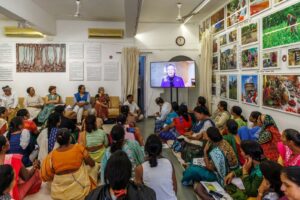 A few associates of Elaben also shared their experiences. Several international dignitaries including former Ireland President and a fellow Elder Mary Robinson and Eileen Alma, Executive Director of Canada-based Coady Institute paid tribute through video messages during the event. Robinson said that Bhatt’s idea of 100-mile communities was an interesting one. “Today SEWA is working towards the Clean Sky initiative and also Project Dandelion for women-led climate justice,” she said. Alma remembered Elaben as an inspiration for many and said that Coady Institute has constituted a scholarship on the occasion.
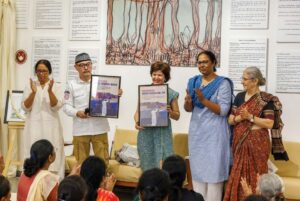 Greenfield in his speech said that they at IUF are as much part of SEWA as SEWA is part of IUF. He said that the passing of Elaben in 2022 was devastating but they are responding to it not with sadness but with strength. “The resolution for celebrating 2nd November as the International Day for Unorganized Women Workers was passed on 16th June in the IUF executive meet where member organizations from 126 countries had participated,” he said. Greenfield added that the crux of Elaben’s message is included in a poster that is prepared in 14 global languages. “It would be distributed on occasions such as International Women’s Day to spread the message of voice, visibility and validation.”
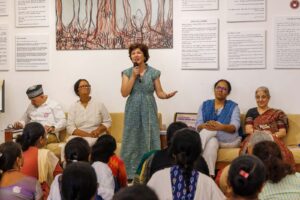 Svetlana Boincean, International Officer for Agriculture and Plantation at IUF, who represented the organization, said that SEWA today plays an important role at IUF and that the day is about Elaben, and also about what a collective strength of women can achieve. “The issues such as gender inequality and pay disparity are very much relevant today – Iceland, one of the countries known for its gender equality, last week observed massive strike for demand of equal pay!”.
At the 5th World Congress of the International Trade Union Confederation in Melbourne, Australia, held from November 17th-22nd, 2022, Jyoti Macwan, General Secretary, SEWA spoke about the importance of Universal Social Protection in the ITUC Women's Conference and again in the ITUC Congress she spoke about the role of Waste Recyclers in the Circular Economy as part of a just transition. In her speech on Universal social security, she stressed upon its importance in the informal sector and its valid budgetary allocation by state as well as central Governments. Social security enhances the earning capacity of workers and ultimately speeds up the National as well as local economy. She mentioned that health care coverage, Child care, education and old age benefits are most essential for these workers. She also recommended the role of trade unions in the registration, disbursement and monitoring of social security schemes to the workers. Similarly, while highlighting the role of waste recyclers in the circular economy she said that waste recyclers are the silent warriors to mitigate climate change. Their recognition and inclusion in the Solid Waste Management program of the city is essential. She urged ITUC to recognise the vulnerability of waste recyclers and accordingly draft a convention for ILO. SEWA, was elected in the ITUC Council and Jyoti Macwan is also Vice President here.
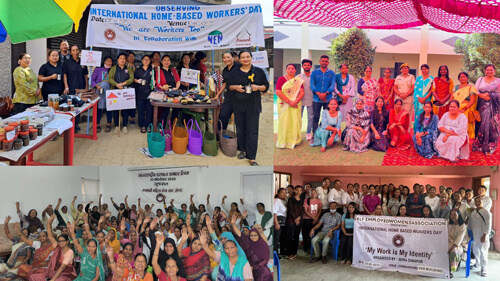 SEWA members demand their role be recognised in circular economy, fair & minimum wages & activation of welfare boards and schemes.
International Home-based Worke
SEWA members demand their role be recognised in circular economy, fair & minimum wages & activation of welfare boards and schemes.
International Home-based Worke
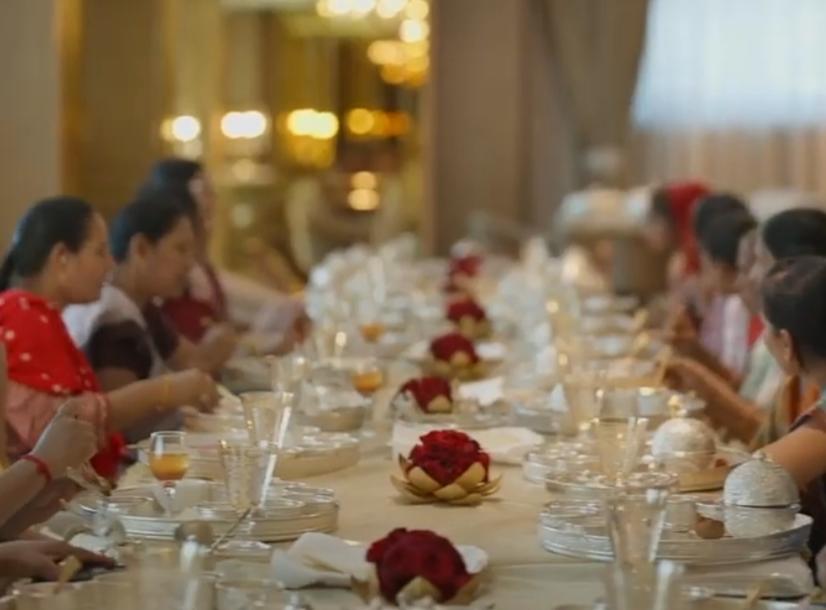 This Women’s Day. we join hands with ITC Hotels to empower female force through shared skills as newer experiences and opportunities unfold.
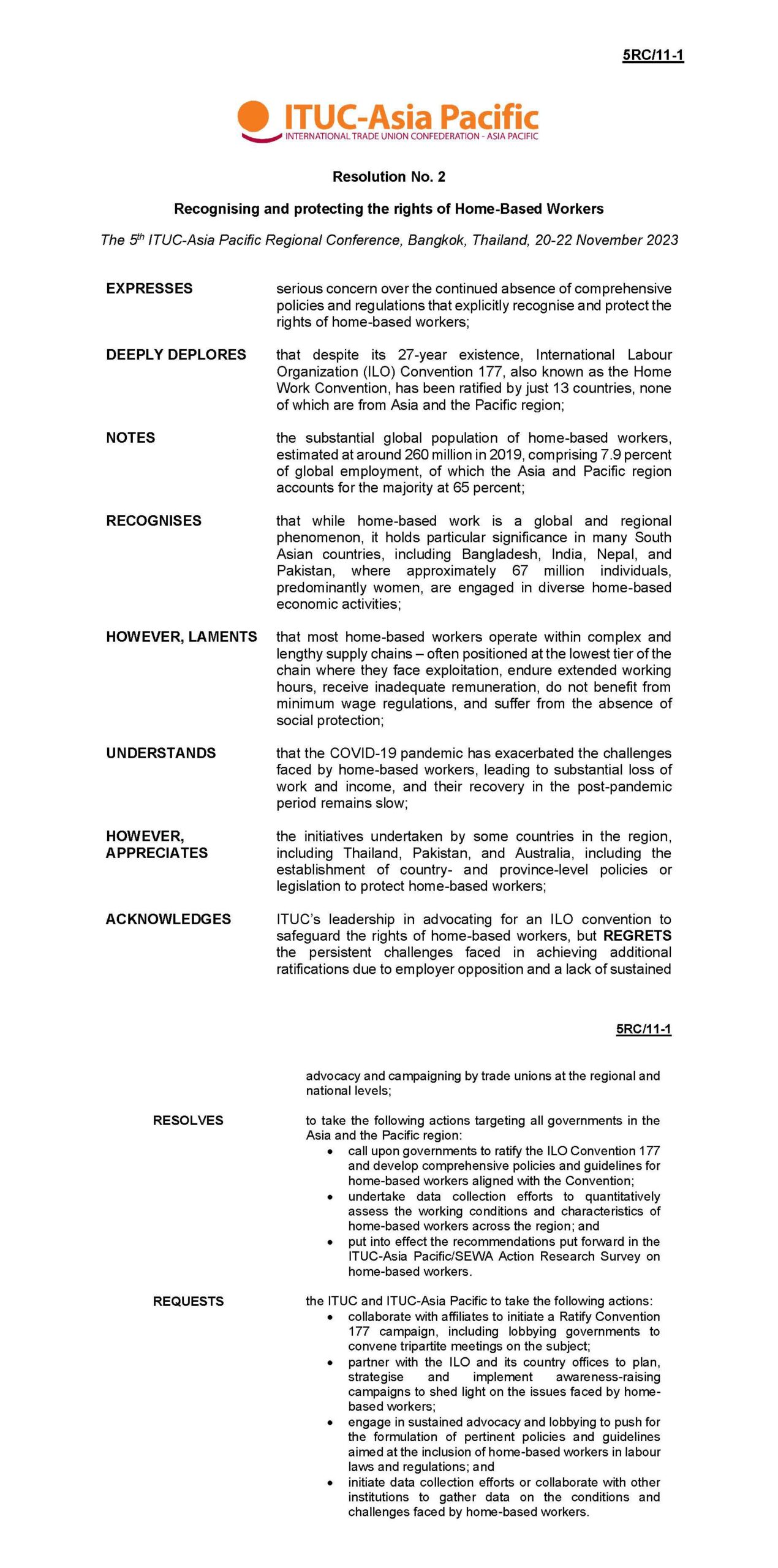 5th ITUC -AP Regional Congress held in the month of November 2023 adopted the Resolution on Home based workers. This Resolution, was moved by SEWA that intends to bring forward this situation of the home based workers and urges ITUC and ITUC AP important actions.
Home based workers segment of workers operates in complex and long supply chains. These workers remain invisible, face exploitation, with long working hours and unstable work as well as incomes. They do not have any social protection either.
5th ITUC -AP Regional Congress held in the month of November 2023 adopted the Resolution on Home based workers. This Resolution, was moved by SEWA that intends to bring forward this situation of the home based workers and urges ITUC and ITUC AP important actions.
Home based workers segment of workers operates in complex and long supply chains. These workers remain invisible, face exploitation, with long working hours and unstable work as well as incomes. They do not have any social protection either.
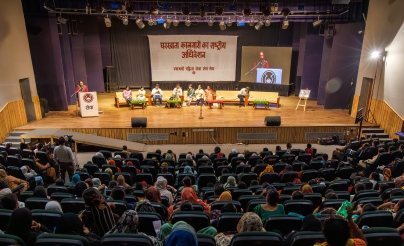 WOMEN WORKERS SHARE THEIR STRUGGLES, INTERNATIONAL STAKEHOLDERS PLEDGE SUPPORT EVEN AS SEWA SUBMITS MEMORANDUM WITH KEY DEMANDS LIKE NATIONAL POLICY FOR HOME BASED WORKERS, SOCIAL SECURITY, PROTECTION AGAINST CLIMATE CHANGE and OCCUPATIONAL HEALTH AND SAFETY
On April 23, 2024, a large army of 1,000 home-based leaders of SEWA from across India, who conventionally toil inside their homes to eke a living, congregated at the Tagore Hall of Ahmedabad city in Gujarat to take part in the National Convention for the Home Based Workers organized by Self Employed Women's Association. The women leaders stepped out of their homes with a unified objective of raising their visibility as workers and a significant contributor to the Gross Domestic Product of the country.
`Today is our day', the home based worker women applauded at the convention which was attended by esteemed guests. The esteemed guests present at the Convention were from International Labour Organization (ILO) Delhi Office Director – Sister Michiko Miyamoto; Brother S. M Fahimuddin Pasha- Director of Worker’s Rights at ITUC-Asia Pacific; Brother Ashutosh Bhattacharya- Regional Secretary, IndustriAll; Sister Shruti Modi- Additional Labour Commissioner, Labour and Employment, Government of Gujarat and Sister Janhavi Dave- Coordination HomeNet International.
Jyoti Macwan, General Secretary of SEWA, who opened the session reminisced how the term Home Based Worker was coined by SEWA founder Elaben Bhatt and propagated globally to give recognition to women making a living by working in different trades from their homes.
"Elaben may not be present with us physically, but SEWA will continue to earnestly follow the path guided by her and committed to achieve the goal of winning Voice, Visibility and Validation for the Home Based Workers," said Macwan.
Manali Shah, National Secretary, SEWA evoked Elaben Bhatt's thoughts and speeches that have motivated women struggling to eke a living in the unorganized sector in the country for decades now. Shah said that part of Elaben's aspirations for the Home Based Workers have been achieved. "The time has come now that we collectively raise the Voice of these workers to make them Visible and get them Validation for their hard work," Shah said.
The general secretary and national secretary submitted a memorandum to Sister Michiko Miyamoto, director of ILO-New Delhi on behalf of SEWA underscoring the demands of an estimated 30 million Home Based Workers in India. Primary demands included that ILO should push the Government to form a comprehensive Policy for the Home Based Workers as a first step in India while the C177 on home work is ratified in the country. Key among other demands included an action research study of Home Based Workers in five states to understand the impact of climate change on their respective trades and develop a local R&D centre for innovation to resolve issues like workplace design, occupational health hazards, lack of skill development and limited knowledge on latest market trends.
https://www.youtube.com/watch?v=Em-PbO7kFxE
A short video depicting work-life challenges of a Home Based Worker was played at the convention. Women leaders from different states where SEWA is working with home-based workers shared the challenges they faced professionally.
Kamla Ben from Bikaner, Rajasthan who rolls papads (lentil crispies eaten along with traditional Indian meals) for the past 20 years raised the important issue of occupational health hazard of poor ergonomics in her trade. "I sit continuously for hours on my knees to give adequate pressure to roll out thin papads which leaves me grappling with chronic knee, back and neck pain. My palms have developed calluses which hurt my children when I cuddle them with love," Kamla Ben said.
The papad rollers expressed apprehension over the adverse impact of climate change on their trade and income as regular unseasonal rains or extreme heat ruin the papad quality minimising their incomes as agents cut their remuneration if the quality of the product is compromised.
Women home-based leaders raised significant issues of the need of social security for them as most trades adversely impacted their health. Women workers also spoke about disparity of work and incomes for them as they work in isolation and lack the skill sets to withstand the Global market demands.
Beedi rollers from West Bengal voiced exploitation by traders/contractors who deducted their remuneration on whim citing petty reasons. "Since the Beedi Workers Welfare Act has been repealed, we are without any security now”.
Women workers stressed the need of social security plans for Home Based Workers enumerated how most of them are not able to educate their children with higher studies and pay medical expenses with their meagre incomes.
Sister Maria Helena, Director, ILO, Geneva shared a Video message on this occasion and recognized the efforts of SEWA to organize the unreachable home-based workers. She acknowledged the large number of women workers in this category of workers and said they remain poor and vulnerable because they are invisible. While remembering SEWA’s efforts for the formation of ILO Convention 177 and Recommendation 198 for the home-based workers, Sister Maria Helena said that these are very important instruments to raise the voice for the rights of the home-based workers.
Sister Helena said that trade unions like SEWA should collectivize the strength and advocate for the ratification of the same in their countries. Organizations like SEWA share the responsibility of shaping a better future of work for the home-based workers and she extended the support of ILO Actrav office in the entire struggle. "The convention is the beginning of the struggles and I give my best wishes for the wishes for the success of it," said Sister Helena.
https://www.youtube.com/watch?v=8BkhexODiyI
Sister Michiko Miyamoto, Director, ILO Delhi office said that hearing voices of women who work from homes was a learning experience for her. She pledged her support on working with SEWA for pushing the Government to form National Policy
for these workers as well as for the ratification of the ILO Convention 177.
"Home Based Workers are many in India and when they all come together, their being organized can become their biggest strength. Training modules of ILO should be used for the same," Sister Miyamoto said.
Brother Fahim Pasha from ITUC AP expressed delight that three generations of women leaders of SEWA were present to represent home based workers at the convention. "Three generations of SEWA women are present and the fourth generation of leaders is getting ready. This is the strength of SEWA. We recognize the movement created by SEWA for the ratification of ILO convention 177 and National Policy for the home-based workers, ITUC AP will support the same," said Brother Pasha who motivated women workers to organize and increase their collective strength.
Brother Ashutosh Bhattacharya from IndustriAll said that he was taken aback by the plight of home based workers. IndustriAll is in solidarity with these women workers. Sister Janhavi from HomeNet International urged SEWA home based workers to acknowledge themselves for the work they do. "Ela ben dreamt of widening the visibility of the home-based workers globally and through HomeNet International, we have been able to achieve it," said Janhavi Ben.
At the end of the Convention, a memorandum was handed over to the esteemed guests from ILO, ITUC AP and IndustriAll. (Link for the Memorandum) and vote of thanks by Sister Madhuri Sinha, General Secretary SEWA in Bihar and Sister Lata Vice President SEWA in Delhi. The national convention ended in keeping with the tradition of SEWA with women workers singing the “We shall overcome” song in different tongues but with a unified spirit.
KEY DEMANDS FROM SEWA'S MOU FOR IMPROVING LIVES & INCOMES OF HOME BASED WORKERS
1. ILO should take forward the drive to ratify the C177 in at least 3 south Asian
countries -India, Nepal, Pakistan.
2. Through tripartite meetings, ILO should develop a comprehensive National Policy for the Home-based workers as a first step in our country while the C177 is being ratified.
3. ILO should conduct an action research study of Home-based work in five States
on the impact of climate change on their trades.
4. We urge the ILO to develop a local Research & Development (R&D) centre for innovation to resolve issues like workspace design, occupational related health issues, lack of skills development and limited knowledge on latest market trends for home-based workers. We urge the State Governments to formulate policy for Home based workers.
5. Government should identify the trades of home-based workers and declare the
minimum wages on piece rate as they are getting the wages on piece rate.
6. Under the E-Shram, the Government should initiate giving social security to home-based workers. It should cover basic social security schemes for - Old age pension; life and disability insurance; child care; maternity benefit; healthcare benefit; education for children and even housing subsidy, as home is their workspace. ILO should support this intervention with the Government. Later trade specific social security schemes should also be developed by the Government.
7. While identifying the significant repercussions of climate change on home- based workers, it is important to devise mechanisms to reduce its adverse effect on these workers as well increase their resilience.
8. Government should link all HBWs with the ESI and it should start with 74 lakhs beedi workers because after repeal of the Beedi and Cigar Workers Welfare CESS Act, 1976, beedi workers are bereft from any social security schemes.
9. Government should include all home-based workers in relevant policies and guidelines in all the labour codes and regulations and ILO should engage itself in interventions at all levels for attaining the same.
10. The Government of India declared the National Policy on Occupational Safety, Health and Environment at Workplace on 9th February 2009. The Policy also aims at providing a statutory framework on Occupational Safety and Health in respect of all sectors. It is required that Home-based workers should also be included in this Policy. A study to understand the effects of their work on their health should be conducted and based on the report of the study, further preventive and curative steps/ measures must be taken. In addition, the Government should conduct a study on occupational health in 5 trades of home-based workers.
11. To ensure the inclusion of the home-based workers in all the present relevant
schemes of the government.
12. A National minimum wage as the work keeps shifting either inter-State or intra-
State depending on the minimum wage in the given city or State.
13. We urge the ITUC-AP to take forward the Resolution No 2 passed in the 5th ITUC -Asia Pacific Regional Conference in Bangkok, Thailand on 20-22 November 2023.
Link of Memorandum
WOMEN WORKERS SHARE THEIR STRUGGLES, INTERNATIONAL STAKEHOLDERS PLEDGE SUPPORT EVEN AS SEWA SUBMITS MEMORANDUM WITH KEY DEMANDS LIKE NATIONAL POLICY FOR HOME BASED WORKERS, SOCIAL SECURITY, PROTECTION AGAINST CLIMATE CHANGE and OCCUPATIONAL HEALTH AND SAFETY
On April 23, 2024, a large army of 1,000 home-based leaders of SEWA from across India, who conventionally toil inside their homes to eke a living, congregated at the Tagore Hall of Ahmedabad city in Gujarat to take part in the National Convention for the Home Based Workers organized by Self Employed Women's Association. The women leaders stepped out of their homes with a unified objective of raising their visibility as workers and a significant contributor to the Gross Domestic Product of the country.
`Today is our day', the home based worker women applauded at the convention which was attended by esteemed guests. The esteemed guests present at the Convention were from International Labour Organization (ILO) Delhi Office Director – Sister Michiko Miyamoto; Brother S. M Fahimuddin Pasha- Director of Worker’s Rights at ITUC-Asia Pacific; Brother Ashutosh Bhattacharya- Regional Secretary, IndustriAll; Sister Shruti Modi- Additional Labour Commissioner, Labour and Employment, Government of Gujarat and Sister Janhavi Dave- Coordination HomeNet International.
Jyoti Macwan, General Secretary of SEWA, who opened the session reminisced how the term Home Based Worker was coined by SEWA founder Elaben Bhatt and propagated globally to give recognition to women making a living by working in different trades from their homes.
"Elaben may not be present with us physically, but SEWA will continue to earnestly follow the path guided by her and committed to achieve the goal of winning Voice, Visibility and Validation for the Home Based Workers," said Macwan.
Manali Shah, National Secretary, SEWA evoked Elaben Bhatt's thoughts and speeches that have motivated women struggling to eke a living in the unorganized sector in the country for decades now. Shah said that part of Elaben's aspirations for the Home Based Workers have been achieved. "The time has come now that we collectively raise the Voice of these workers to make them Visible and get them Validation for their hard work," Shah said.
The general secretary and national secretary submitted a memorandum to Sister Michiko Miyamoto, director of ILO-New Delhi on behalf of SEWA underscoring the demands of an estimated 30 million Home Based Workers in India. Primary demands included that ILO should push the Government to form a comprehensive Policy for the Home Based Workers as a first step in India while the C177 on home work is ratified in the country. Key among other demands included an action research study of Home Based Workers in five states to understand the impact of climate change on their respective trades and develop a local R&D centre for innovation to resolve issues like workplace design, occupational health hazards, lack of skill development and limited knowledge on latest market trends.
https://www.youtube.com/watch?v=Em-PbO7kFxE
A short video depicting work-life challenges of a Home Based Worker was played at the convention. Women leaders from different states where SEWA is working with home-based workers shared the challenges they faced professionally.
Kamla Ben from Bikaner, Rajasthan who rolls papads (lentil crispies eaten along with traditional Indian meals) for the past 20 years raised the important issue of occupational health hazard of poor ergonomics in her trade. "I sit continuously for hours on my knees to give adequate pressure to roll out thin papads which leaves me grappling with chronic knee, back and neck pain. My palms have developed calluses which hurt my children when I cuddle them with love," Kamla Ben said.
The papad rollers expressed apprehension over the adverse impact of climate change on their trade and income as regular unseasonal rains or extreme heat ruin the papad quality minimising their incomes as agents cut their remuneration if the quality of the product is compromised.
Women home-based leaders raised significant issues of the need of social security for them as most trades adversely impacted their health. Women workers also spoke about disparity of work and incomes for them as they work in isolation and lack the skill sets to withstand the Global market demands.
Beedi rollers from West Bengal voiced exploitation by traders/contractors who deducted their remuneration on whim citing petty reasons. "Since the Beedi Workers Welfare Act has been repealed, we are without any security now”.
Women workers stressed the need of social security plans for Home Based Workers enumerated how most of them are not able to educate their children with higher studies and pay medical expenses with their meagre incomes.
Sister Maria Helena, Director, ILO, Geneva shared a Video message on this occasion and recognized the efforts of SEWA to organize the unreachable home-based workers. She acknowledged the large number of women workers in this category of workers and said they remain poor and vulnerable because they are invisible. While remembering SEWA’s efforts for the formation of ILO Convention 177 and Recommendation 198 for the home-based workers, Sister Maria Helena said that these are very important instruments to raise the voice for the rights of the home-based workers.
Sister Helena said that trade unions like SEWA should collectivize the strength and advocate for the ratification of the same in their countries. Organizations like SEWA share the responsibility of shaping a better future of work for the home-based workers and she extended the support of ILO Actrav office in the entire struggle. "The convention is the beginning of the struggles and I give my best wishes for the wishes for the success of it," said Sister Helena.
https://www.youtube.com/watch?v=8BkhexODiyI
Sister Michiko Miyamoto, Director, ILO Delhi office said that hearing voices of women who work from homes was a learning experience for her. She pledged her support on working with SEWA for pushing the Government to form National Policy
for these workers as well as for the ratification of the ILO Convention 177.
"Home Based Workers are many in India and when they all come together, their being organized can become their biggest strength. Training modules of ILO should be used for the same," Sister Miyamoto said.
Brother Fahim Pasha from ITUC AP expressed delight that three generations of women leaders of SEWA were present to represent home based workers at the convention. "Three generations of SEWA women are present and the fourth generation of leaders is getting ready. This is the strength of SEWA. We recognize the movement created by SEWA for the ratification of ILO convention 177 and National Policy for the home-based workers, ITUC AP will support the same," said Brother Pasha who motivated women workers to organize and increase their collective strength.
Brother Ashutosh Bhattacharya from IndustriAll said that he was taken aback by the plight of home based workers. IndustriAll is in solidarity with these women workers. Sister Janhavi from HomeNet International urged SEWA home based workers to acknowledge themselves for the work they do. "Ela ben dreamt of widening the visibility of the home-based workers globally and through HomeNet International, we have been able to achieve it," said Janhavi Ben.
At the end of the Convention, a memorandum was handed over to the esteemed guests from ILO, ITUC AP and IndustriAll. (Link for the Memorandum) and vote of thanks by Sister Madhuri Sinha, General Secretary SEWA in Bihar and Sister Lata Vice President SEWA in Delhi. The national convention ended in keeping with the tradition of SEWA with women workers singing the “We shall overcome” song in different tongues but with a unified spirit.
KEY DEMANDS FROM SEWA'S MOU FOR IMPROVING LIVES & INCOMES OF HOME BASED WORKERS
1. ILO should take forward the drive to ratify the C177 in at least 3 south Asian
countries -India, Nepal, Pakistan.
2. Through tripartite meetings, ILO should develop a comprehensive National Policy for the Home-based workers as a first step in our country while the C177 is being ratified.
3. ILO should conduct an action research study of Home-based work in five States
on the impact of climate change on their trades.
4. We urge the ILO to develop a local Research & Development (R&D) centre for innovation to resolve issues like workspace design, occupational related health issues, lack of skills development and limited knowledge on latest market trends for home-based workers. We urge the State Governments to formulate policy for Home based workers.
5. Government should identify the trades of home-based workers and declare the
minimum wages on piece rate as they are getting the wages on piece rate.
6. Under the E-Shram, the Government should initiate giving social security to home-based workers. It should cover basic social security schemes for - Old age pension; life and disability insurance; child care; maternity benefit; healthcare benefit; education for children and even housing subsidy, as home is their workspace. ILO should support this intervention with the Government. Later trade specific social security schemes should also be developed by the Government.
7. While identifying the significant repercussions of climate change on home- based workers, it is important to devise mechanisms to reduce its adverse effect on these workers as well increase their resilience.
8. Government should link all HBWs with the ESI and it should start with 74 lakhs beedi workers because after repeal of the Beedi and Cigar Workers Welfare CESS Act, 1976, beedi workers are bereft from any social security schemes.
9. Government should include all home-based workers in relevant policies and guidelines in all the labour codes and regulations and ILO should engage itself in interventions at all levels for attaining the same.
10. The Government of India declared the National Policy on Occupational Safety, Health and Environment at Workplace on 9th February 2009. The Policy also aims at providing a statutory framework on Occupational Safety and Health in respect of all sectors. It is required that Home-based workers should also be included in this Policy. A study to understand the effects of their work on their health should be conducted and based on the report of the study, further preventive and curative steps/ measures must be taken. In addition, the Government should conduct a study on occupational health in 5 trades of home-based workers.
11. To ensure the inclusion of the home-based workers in all the present relevant
schemes of the government.
12. A National minimum wage as the work keeps shifting either inter-State or intra-
State depending on the minimum wage in the given city or State.
13. We urge the ITUC-AP to take forward the Resolution No 2 passed in the 5th ITUC -Asia Pacific Regional Conference in Bangkok, Thailand on 20-22 November 2023.
Link of Memorandum
 [caption id="attachment_3027" align="alignnone" width="300"]
 Gilbert F. Houngbo, Director-General of the ILO meets with Jyoti Macwan, SEWA Trade Union, India, Geneva, Switzerland. 10 May 2024. Photo Violaine Martin / ILO[/caption]
Recently, in a meeting with the 11th Director General of the ILO, Gilbert F. Hungbo, SEWA's General Secretary, Jyotiben Macwan, had the honor to engage in a meaningful dialogue on Future of Work for informal sector women workers and Climate Action. This meeting marked a significant moment for SEWA, a pioneering union of over 2.9 million poor, informal sector women workers that has advocated for full employment and self-reliance for over five decades.
Jyotiben highlighted SEWA’s innovative joint action of struggle and development - a model that integrates the strength of unionism and collective bargaining power with the cooperative movement. This dual approach has empowered countless women, bringing them a voice and visibility to their work while fostering economic independence and asset creation through worker-owned and managed initiatives and enterprises like the SEWA Cooperative Bank—established in 1974 as the first of its kind for poor women; RUDI, an agribusiness enterprise managed by over 250,000 smallholders and many more.
With over 35-40 % of SEWA’s membership comprising young women keen on leveraging modern technology, Jyotiben underscored SEWA’s commitment to reskilling, upskilling and skill diversification. These efforts ensure members are well-equipped for the evolving employment opportunities in an increasingly tech-savvy world. SEWA is also at the forefront of deploying technology that enhances the lives and livelihoods of its members and generates new and innovative employment opportunities for the youth, without replacing traditional work. Innovations such as customized mobile apps for membership management, financial transactions and health monitoring, alongside green tech solutions like solar precision irrigation, biogas etc. exemplify SEWA’s approach to make work smarter and more dignified.
But when we are talking about Future of Work, delving on the most pressing issue of climate change – a significant disruptor of lives and livelihoods for the poor. is unavoidable. Therefore, amidst these advancements, SEWA has galvanized its 2.9 million members to commit to climate action through the “Building Cleaner Skies” campaign. This campaign educates members on climate change, its impacts and promotes resilient practices to safeguard their future.
The conversation with Director General Hungbo was not only a reflection of SEWA’s enduring mission but also an opportunity to illustrate how SEWA’s grassroots strategies provide valuable insights for global labor unions, particularly in similar contexts across the Global South – especially in the African sub-continent. He praised SEWA’s efforts in bringing visibility, voice, and validity to the informal sector’s work, acknowledging the potential of SEWA’s model as a blueprint for similar communities globally.
In concluding this impactful exchange, Jyotiben reinforced that SEWA does not differentiate between formal and informal work; it champions the recognition of all work as the cornerstone of societal cohesion. However, with over 93% of the global workforce in the informal economy, SEWA advocates for these workers to be central in all policy-design and implementation processes, ensuring their significant economic contributions are recognized and supported.
As we move forward, SEWA continues to strengthen the fabric of society by weaving together the threads of collective strength, equity, sustainability, and resilience, making every worker’s contribution visible and valuable.
Gilbert F. Houngbo, Director-General of the ILO meets with Jyoti Macwan, SEWA Trade Union, India, Geneva, Switzerland. 10 May 2024. Photo Violaine Martin / ILO[/caption]
Recently, in a meeting with the 11th Director General of the ILO, Gilbert F. Hungbo, SEWA's General Secretary, Jyotiben Macwan, had the honor to engage in a meaningful dialogue on Future of Work for informal sector women workers and Climate Action. This meeting marked a significant moment for SEWA, a pioneering union of over 2.9 million poor, informal sector women workers that has advocated for full employment and self-reliance for over five decades.
Jyotiben highlighted SEWA’s innovative joint action of struggle and development - a model that integrates the strength of unionism and collective bargaining power with the cooperative movement. This dual approach has empowered countless women, bringing them a voice and visibility to their work while fostering economic independence and asset creation through worker-owned and managed initiatives and enterprises like the SEWA Cooperative Bank—established in 1974 as the first of its kind for poor women; RUDI, an agribusiness enterprise managed by over 250,000 smallholders and many more.
With over 35-40 % of SEWA’s membership comprising young women keen on leveraging modern technology, Jyotiben underscored SEWA’s commitment to reskilling, upskilling and skill diversification. These efforts ensure members are well-equipped for the evolving employment opportunities in an increasingly tech-savvy world. SEWA is also at the forefront of deploying technology that enhances the lives and livelihoods of its members and generates new and innovative employment opportunities for the youth, without replacing traditional work. Innovations such as customized mobile apps for membership management, financial transactions and health monitoring, alongside green tech solutions like solar precision irrigation, biogas etc. exemplify SEWA’s approach to make work smarter and more dignified.
But when we are talking about Future of Work, delving on the most pressing issue of climate change – a significant disruptor of lives and livelihoods for the poor. is unavoidable. Therefore, amidst these advancements, SEWA has galvanized its 2.9 million members to commit to climate action through the “Building Cleaner Skies” campaign. This campaign educates members on climate change, its impacts and promotes resilient practices to safeguard their future.
The conversation with Director General Hungbo was not only a reflection of SEWA’s enduring mission but also an opportunity to illustrate how SEWA’s grassroots strategies provide valuable insights for global labor unions, particularly in similar contexts across the Global South – especially in the African sub-continent. He praised SEWA’s efforts in bringing visibility, voice, and validity to the informal sector’s work, acknowledging the potential of SEWA’s model as a blueprint for similar communities globally.
In concluding this impactful exchange, Jyotiben reinforced that SEWA does not differentiate between formal and informal work; it champions the recognition of all work as the cornerstone of societal cohesion. However, with over 93% of the global workforce in the informal economy, SEWA advocates for these workers to be central in all policy-design and implementation processes, ensuring their significant economic contributions are recognized and supported.
As we move forward, SEWA continues to strengthen the fabric of society by weaving together the threads of collective strength, equity, sustainability, and resilience, making every worker’s contribution visible and valuable.
 Gujarat, November 2, 2024 – On the occasion of the 2nd Death Anniversary of SEWA’s founder Ela Bhatt, hundreds of SEWA members were joined by Ms. Sue Longley, General Secretary of the International Union of Food, Agricultural, Hotel, Restaurant, Catering, Tobacco, and Allied Workers' Associations (IUF) to honors SEWA’s visionary founder Smt. Ela Bhatt at SEWA’s office in Ahmedabad. In a historic move, IUF has passed a declaration that November 2nd will be celebrated globally as the “International Day for Informal Workers.”
Over 407 affiliates of IUF across 126 countries globally celebrated this day, remembering Elaben. As SEWA’s aagevans (grassroots leaders) shared their memories and inspirational interactions with “their Elaben”, Mr. Hidayat Greenfield, Regional Secretary of IUF shared pictures of celebration of this day by various affiliates across the globe, stating that “SEWA sisters are saying ‘our ELABEN’, but now onwards with this International celebration of 2nd November all Affiliates of IUF will also say ‘OUR ELABEN’”
At the event, SEWA General Secretary Jyoti Macwan emphasized the importance of this day, stating, “It is vital that the global community recognizes November 2nd as a day dedicated to informal workers. We are committed to ensuring this day is celebrated widely, with the support of trade unions, UN agencies, and international organizations. It will be a long process, but at SEWA, we embrace it as a “Constructive Struggle” Jyotiben also explained how the “International Day for Informal Workers” will highlight a new theme each year, with “Effective Leadership” as the focus for 2024–2025. SEWA’s grassroots members and IUF affiliates worldwide will come together to organize activities and raise awareness around the unique challenges and contributions of informal workers. As the first global union federation to recognize SEWA’s work in organizing informal women workers, IUF has been a steadfast ally to SEWA for over 40 years. Congratulating Ms. Longley on her historic election as the first woman to lead IUF, SEWA General Secretary Jyoti Macwan said, “In the past 40 years, SEWA, under the guidance of Elaben, has worked closely with IUF and visionary leaders. But today, we are especially proud of sister Sue Longley. Her leadership is encouraging for women in the trade union movement.” Reflecting on Ela Bhatt’s legacy, SEWA Vice President Heenaben Dave shared how Elaben’s vision shaped SEWA into a forward-thinking union. “Elaben believed in a member-centric approach. She encouraged us to take proactive steps for our members’ well-being. The world often discussed challenges SEWA had already addressed,” she said. For instance, SEWA’s Agriculture Campaign, launched in 1987, sought to empower women as farmers and entrepreneurs, challenging the long-standing question Elaben posed: “Why does a farmer remain hungry?” This campaign now supports over 55% of SEWA’s members in agriculture through treating farm as an enterprise, enabling capacity building, access to agro-inputs and technology, finance, and markets and integrating women workers higher up in the agricultural value chain.
At the event, SEWA President Ramilaben Parmar spoke of the personal impact Elaben had on her life: “Thanks to Elaben’s encouragement, I overcame depression, organized thousands of women in my district, and today, I proudly serve as SEWA’s President.”
Champaben, a street vendor, shared how Elaben’s relentless optimism sustained them through years of struggle. “Elaben always encouraged us saying there is no space for the word ‘No’ in our dictionary,” Champaben recalled. “Due to our persistence, we not only achieved a law for street vendors but also earned recognition. The municipal corporation in Ahmedabad is now building five organic markets for us, involving SEWA in the design and planning process.”
Reflecting on Ela Bhatt’s legacy, SEWA Vice President Heenaben Dave shared how Elaben’s vision shaped SEWA into a forward-thinking union. “Elaben believed in a member-centric approach. She encouraged us to take proactive steps for our members’ well-being. The world often discussed challenges SEWA had already addressed,” she said. For instance, SEWA’s Agriculture Campaign, launched in 1987, sought to empower women as farmers and entrepreneurs, challenging the long-standing question Elaben posed: “Why does a farmer remain hungry?” This campaign now supports over 55% of SEWA’s members in agriculture through treating farm as an enterprise, enabling capacity building, access to agro-inputs and technology, finance, and markets and integrating women workers higher up in the agricultural value chain.
At the event, SEWA President Ramilaben Parmar spoke of the personal impact Elaben had on her life: “Thanks to Elaben’s encouragement, I overcame depression, organized thousands of women in my district, and today, I proudly serve as SEWA’s President.”
Champaben, a street vendor, shared how Elaben’s relentless optimism sustained them through years of struggle. “Elaben always encouraged us saying there is no space for the word ‘No’ in our dictionary,” Champaben recalled. “Due to our persistence, we not only achieved a law for street vendors but also earned recognition. The municipal corporation in Ahmedabad is now building five organic markets for us, involving SEWA in the design and planning process.”
 Reflecting on her deep connection with SEWA's leaders, Ms. Longley shared, “I may be the first woman General Secretary of IUF, but seeing the confidence and leadership of SEWA’s grassroots leaders gives me hope—I won’t be the last. Elaben’s work continues to inspire us all to empower informal workers and honor their voices.”
In closing, Ms. Longley acknowledged the path forward may be challenging, but IUF stands with SEWA to assure the International Day for Informal Workers gains global acceptance. “We recognize there may be resistance, but we are prepared to join SEWA in this constructive struggle,” she affirmed.
Reflecting on her deep connection with SEWA's leaders, Ms. Longley shared, “I may be the first woman General Secretary of IUF, but seeing the confidence and leadership of SEWA’s grassroots leaders gives me hope—I won’t be the last. Elaben’s work continues to inspire us all to empower informal workers and honor their voices.”
In closing, Ms. Longley acknowledged the path forward may be challenging, but IUF stands with SEWA to assure the International Day for Informal Workers gains global acceptance. “We recognize there may be resistance, but we are prepared to join SEWA in this constructive struggle,” she affirmed.
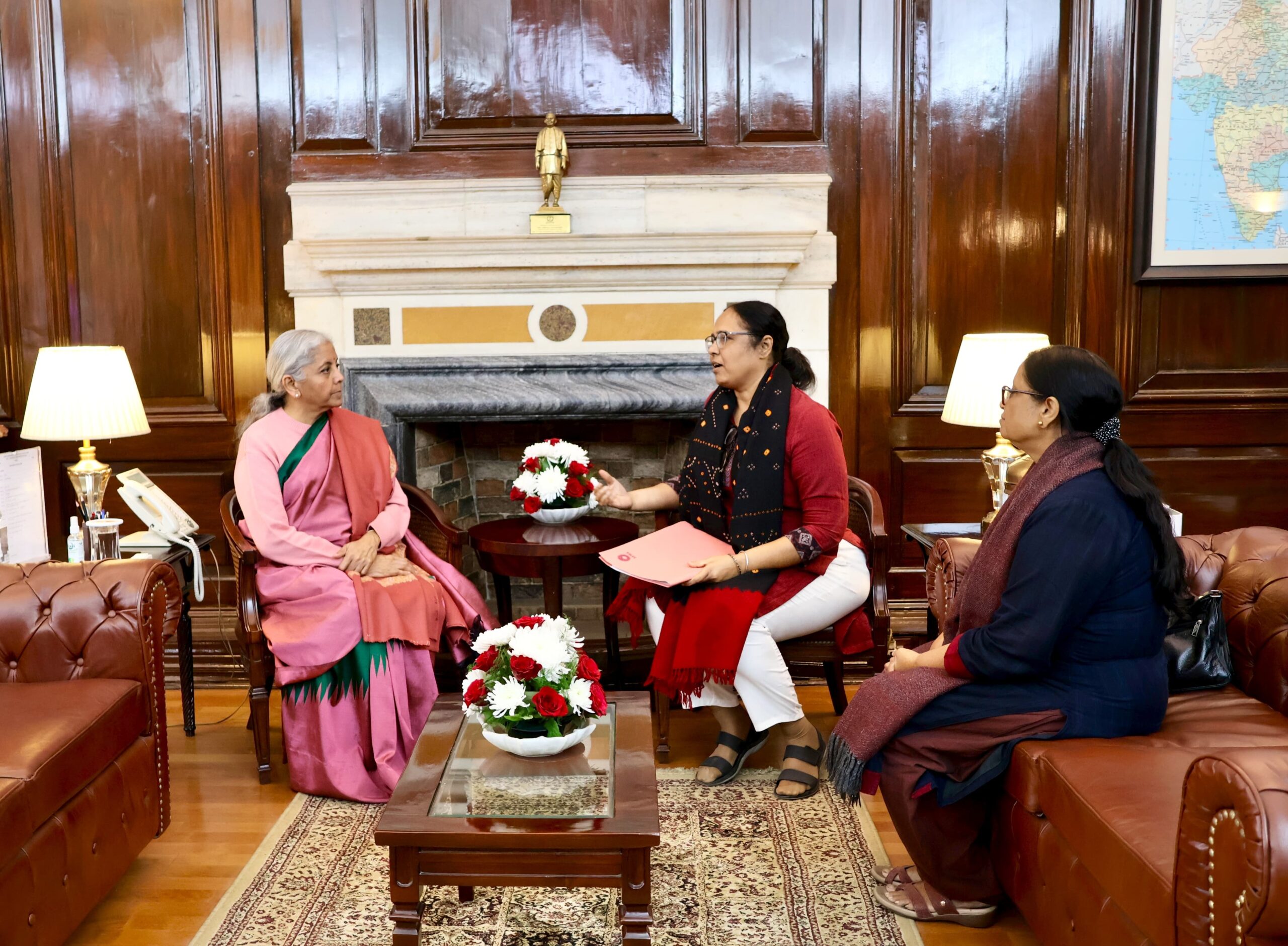 In the first week of January 2025, SEWA represented in the Pre-budget meeting being called upon by the Honorable National Finance Minister Ms. Nirmala Sitharaman. Each year all the National Trade Unions are invited by the Finance Ministry to give their worker centric suggestions in the Union budget being formed for that year. Manali Shah represented SEWA and this year too she talked about various aspects pertaining to the informal economy workers and social security for them. She submitted a Memorandum to the Honorable Minister in this regard.
Shri. Nirmala ji further enquired about the following issues with SEWA
In the first week of January 2025, SEWA represented in the Pre-budget meeting being called upon by the Honorable National Finance Minister Ms. Nirmala Sitharaman. Each year all the National Trade Unions are invited by the Finance Ministry to give their worker centric suggestions in the Union budget being formed for that year. Manali Shah represented SEWA and this year too she talked about various aspects pertaining to the informal economy workers and social security for them. She submitted a Memorandum to the Honorable Minister in this regard.
Shri. Nirmala ji further enquired about the following issues with SEWA
