
A tripartite meeting on Provident Fund (PF) issues of beedi (Indian Cigarettes) rollers was held on 6 January 2026 at Nimitita village, Suti II block located in the Jangipuri sub-division of Murshidabad district, West Bengal. The meeting was organised in the hall of the Beedi Merchant’s Association and brought together representatives of the
Provident Fund authorities, beedi employers, and beedi workers thus creating an important platform for dialogue on long-standing PF-related challenges faced by beedi rollers in the region.
According to official labour statistics, West Bengal has over 18 lakh beedi workers, making it one of the largest beedi-producing States in the country. Within this, Murshidabad district and particularly the Jangipur subdivision forms a major concentration, with approximately 10 lakh beedi workers, as per district-level official data. An estimated 90 per cent of these workers are home-based, and around 70 per cent are women who are engaged in highly informal and fragmented production systems. Also, of the total workers enrolled in this region in PF 80% of them are
Beedi workers.
E-shram data for Murshidabad region indicates that while there are approximately 11 lakh PF accounts, only about 4.38 lakh are Aadhaar verified and around 3.73 lakh are currently active EPFO members. In addition, large gaps remain in mobile and bank account seeding, resulting in several lakh number of inoperative PF accounts, 80 percent of them linked to beedi establishments. This data underscores the systemic and administrative barriers that prevent beedi workers from accessing their PF entitlements, despite long years of contribution.
The beedi rollers in the region work under piece-rate through multiple layers of mahajans (contractors) without written contracts, wage slips or clear employer identification. Despite contributing to the Provident Fund system for decades, many workers remain unable to access their PF entitlements due to a combination of inoperative accounts, lack of awareness about UAN numbers, limited digital and financial literacy, administrative complexities and the absence of accessible service centres.
This meeting was made possible through the consistent follow-up by the representative of Self-Employed Women’s Association (SEWA) in the Central Board of Trustees (CBT). SEWA has constantly raised the concerns of beedi workers and the inoperative PF accounts in the CBT meetings to raise the attention of both -the employers and PF authorities at the district level.
The tripartite meeting was attended by Mr. P. C. Gupta, Regional Provident Fund Commissioner, Berhampore and Mr. Sajal Brahma, Assistant Provident Fund Commissioner, Berhampore. From the employers’ side, Mr. Rajkumar Jain, General Secretary, Beedi Merchants Association, Mr. Abdul Malik of Pataka Industries, and representatives from Jehangir and Das Beedi Industries were present. The meeting also saw the participation of beedi workers from the village, along with representatives of SEWA. The presence of all three stakeholders – government, employers and workers enabled a meaningful tripartite dialogue.
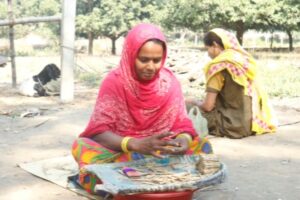
Beedi rolling in Murshidabad is largely home-based on piece-rate and carried out by women under multiple layers of contractors (mahajans). Workers rarely receive written contracts, wage slips or clear information about their employers, making accountability difficult. In many cases, contractors are relatives or known family members, leading workers to place blind trust in them and hesitate to question deductions, payments or Provident Fund contributions.
Beyond PF-related concerns, beedi workers face chronic low wages, irregular availability of raw material, delayed payments and poor bargaining power. Long working hours in poorly ventilated homes expose women to serious occupational health risks including respiratory illnesses, eye strain and musculoskeletal disorders.
Together, these conditions reflect the broader challenges of informality, lack of social security and limited access to grievance redressal for beedi workers in the region.
It was highlighted by the beedi workers in the meeting that there are large number of inoperative PF accounts, lying dormant for years because they do not have awareness about the UAN numbers and so they are not able to track information about the contributions. Moreover, there is uncertainty about the primary employers as there are multiple contractors involved in the long supply chain. The workers also pointed out that they work under more than one Mahajans simultaneously that also leads to fragmentation in the PF records.
One of the important issues that was raised by the beedi workers was regarding linking the Aadhar cards with the mobile numbers. As they frequently change the mobile numbers the access to online PF services is hindered. Connectivity in the remote villages that they belong to also limits their accessibility of their PF accounts.
Low level of literacy, digital literacy and financial literacy are also some of the important causes for inaccessibility of these accounts Several workers brought old PF receipts dating back many years, demonstrating that deductions were made regularly, but benefits were never accessed. For many women, travelling to Berhampore or navigating online portals is costly, confusing and intimidating, resulting in continued exclusion from social security. The present PF
regional office is 100 Km from where the women beedi workers are based. Thus, its accessibility is expensive and time consuming for these workers.
In villages like Nimitita and surrounding areas, access to smartphones, stable internet updated Aadhaar-mobile linkages and digital literacy are really challenging. As a result, beedi rollers continue to depend on intermediaries, increasing the risk of misinformation and exploitation.
Some of the major outcomes of the meeting was the decision to organise three PF facilitation camps over the next three months to address workers’ cases directly beginning from January 27, 2026. This camp will be attended by approximately beedi workers for case-based support. Further, SEWA will closely monitor the outcomes of
the first camp, document unresolved issues, and assess systemic gaps. Based on this, further engagement with PF authorities and employers will be planned.
A very significant demand emerged from the that requires urgent resolution that a PF service/facilitation centre closer to the village where large number of beedi workers are based, in Jangipuri, should be established to accessibility ease for these workers. SEWA will take forward this demand of the beedi workers and will write to
the Central Provident Fund Commissioner for this centre and also ask them for regularly conducting facilitation camps in high-concentration beedi areas that will support mechanisms as well as sensitise the department to the realities of informal, home-based women workers.
Another important agreement was that a tripartite meeting will be convened again after three months to review progress, assess outcomes of the PF camps, and plan further interventions.
This meeting brought together workers, employers and the Provident Fund authorities for an important and meaningful discussion. The opportunity to listen to the perspectives of all three stakeholders contributed to a more balanced understanding of the challenges and possible ways forward, making the discussion both inclusive and solution-oriented.