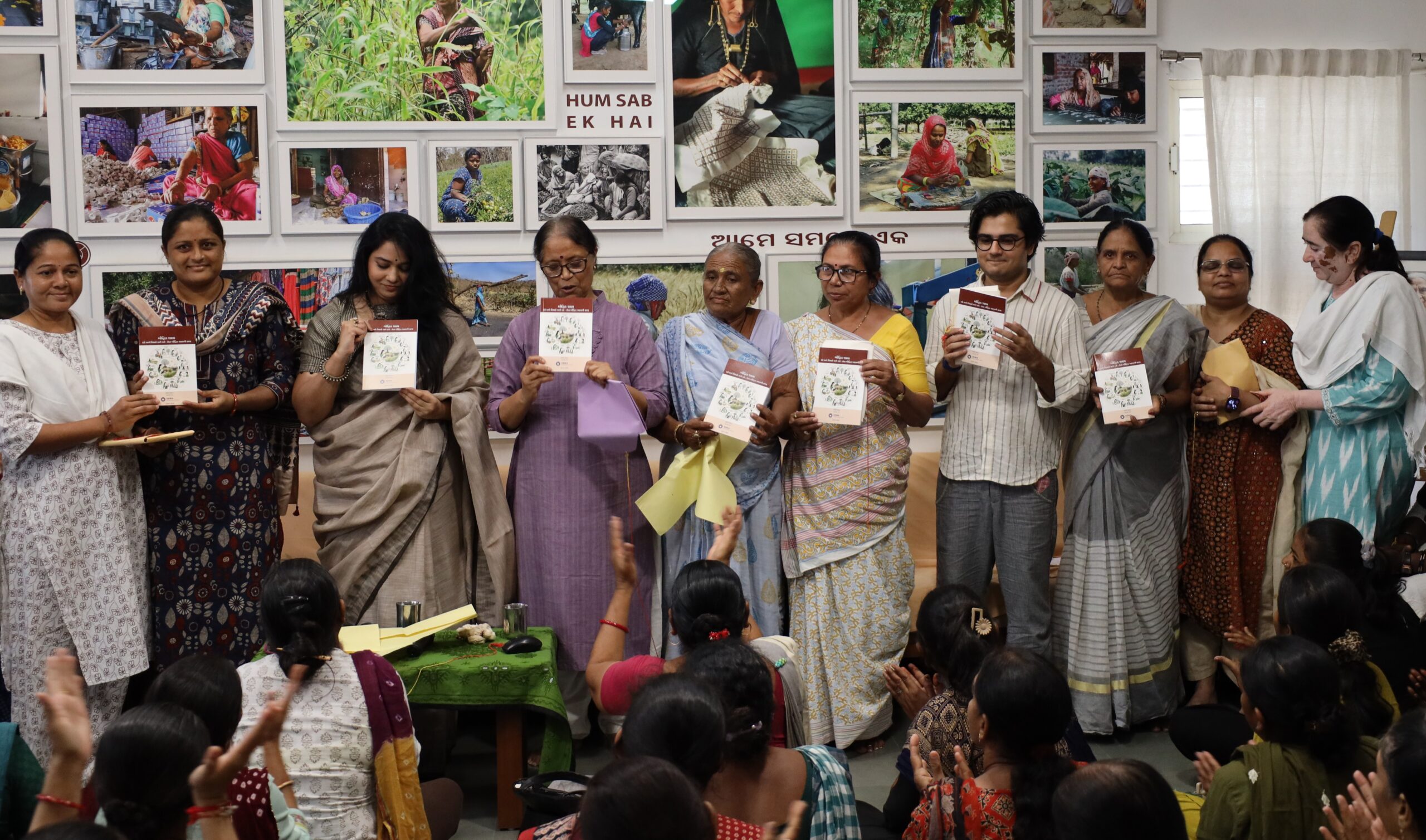
On the occasion of the 93rd birth anniversary of SEWA founder Elaben Bhatt, the Self-Employed Women’s Association (SEWA) launched ShramGaan, (Songs of Work and Dignity) a special initiative celebrating the deep connection between women, work and music. On this occasion SEWA also organised the launch of Baudhik Shala (School of Wisdom) compilation, the learning and reflections sessions organised by Elaben for all of us.
The launch programme was held at SEWA Chowk, SEWA Reception Centre, Ahmedabad, and brought together SEWA executive committee, leaders and organisers. The programme began with SEWA’s Sarvadharma Prayer, (all religion prayer) followed by reflections on Elaben’s life, her work and belief that women workers have deep connection with music and prayer, and the inspiration that led to the creation of ShramGaan.
 Remembering Elaben on her birthday SEWA leader Pavanba from Kutch delightedly shared… “One time Ela ben had visited my village and asked me about my life story… I told her how organizing with SEWA has transformed my life through training and meeting other women like me that inspired and encouraged myself and other women to stand on their feet. I started my own business, formed savings groups, took out loans, educated my children and even learnt how to ride a scooter. Today thanks to SEWA, I have married both my daughters and helped my sons set-up their own businesses. When I shared my story with Ela ben, she sent me a letter that she found my story very inspiring.. and would want me to share the same in Boudhik Shala. That letter from Ela ben is more precious than a treasure. I have still kept it safely in my locker.”
Savita ben, a street vendor leader recalled about her introduction to Elaben and SEWA. She was in class 10 when she first met ben when she accompanied her mother for a trade committee meeting. She said she was really fascinated to meet Ela ben. Elaben called her ask
ed her, if she wants to work in SEWA. She said, “I was happy, but Ela ben said complete your studies first and then come to me. Back then I was really aggressive and never understood about SEWA ‘s Gandhinan Values. I once fought with my mother when she gave bribe to the police person while vending but said she has no money for my fees.” Further she fondly remembers Elaben and said, “ As I grew older and comp
leted my studies, I became leader in SEWA, But my aggression has not clamed. I often picked up fights with police or traffic officers. Ben heard about this, She without any arguments with me, she put me into desk work as a punishment. She said unless I learn to calm down and have discipline in my conduct, I cannot be in the markets as well as work with the street vendors. She taught me to control my anger and from her I learned to be more disciplined and control my aggression.”
Where Work Has Rhythm and Every Woman Carries a SongMusic had always been a very important part of Elaben’s life and she always used to say that when women sing while working, songs related to their trades… those songs give her the strength to live her life, they reflect various aspects of their work-life… their pain, sorrows and struggle as well as joy.
Remembering Elaben’s deep connection to music, Namrataben, shared “When I first joined SEWA, Ela Ben asked me… do you know how to do Garba (traditional Gujarati folk-dance) … I was confused… but she explained that when we go to organize street vendors, participating with them in Garba would help build relations and trust. A few years later when we were planning on setting-up SEWA Academy, she insisted that along with trainings, Academy must focus on folk songs and folk dance.”
Similarly a Bhavna ben, a agriculture leader from Chota Udaipur said she had very few opportunities to meet Ela ben but she remembered that Ela ben was always very eager to know about us and our work. She taught us how we should behave and bring calmness in ourselves while we work. She said ben also insisted that songs are integral part of organising and its trainings, it gives encouragement, motivation to our members. We should imbibe music and songs in our trainings and can subtly share what we want to share. Their songs carry experiences, knowledge, memories, struggles, hopes and aspirations. 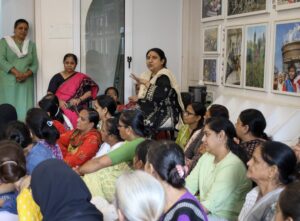
ShramGaan has been created to recognise, document, preserve and celebrate this living musical heritage. It brings together the voices, songs, experiences and cultural traditions of members and seeks to share them with a wider audience. At a time when traditional folk music and songs are gradually disappearing in many places, ShramGaan is also an effort to preserve this valuable cultural heritage for future generations.
Launch of the ShramGaan Webpage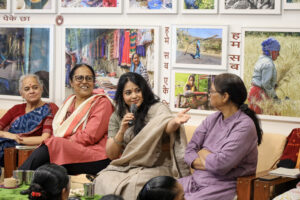
Launching the Shram Gaan Webpage, Mirandeben said “ I had heard about SEWA a lot, but had not known that its founder Elaben was so passionate about music. In India, making a space for herself has always been a struggle for women – both within and outside her home. These struggles often break a woman’s confidence and self-respect. It is a mental struggle. And Elaben has not just set-up SEWA as a trade union but helped millions of women overcome this mental struggle. I also strongly believe that any form of work – although it is generally looked upon as a means of earning, – but more importantly, it is worship… and when you attach music with this worship, it transcends to meditative experience. Most of the Shram Gaans such as “Ghammar Ghammar maaru Valonu gaaje” or “Dham Dhamak dham dham dham Sambelu”, always have reference to the sound of the work… and link to the rhythm of work… this is the key to alleviating pain and Elaben understood this and hence encourage women to sing while working. I am very happy to see that you are continuing this legacy of Elaben through this ShramGaan.
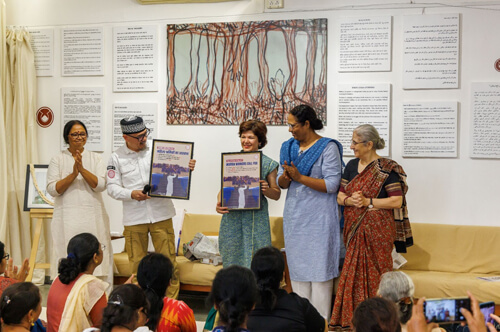
Launch of Boudhik Shala (School of Wisdom)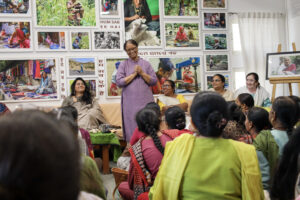 This was followed by the launch of book on Baudhik Shala of SEWA, a booklet compiled by Jyoti ben Macwan, General Secretary of SEWA, based on series of Baudhik Shalas organised by our Elaben on range of subjects.. Jyoti ben with her fond memories of Ben shared that, “Baudhik Shala sessions were very important for Ela ben. She was very particular about them and ensured we do it regularly. She wanted that all the leaders, members and everybody should learn to think beyond work and daily activities, look beyond our everyday work and connect deeper ideas with our actions and SEWA’s values. Through 28 sessions of Baudhik Shala that ben conducted, she taught us to think and this book is my remembrance of being with ben through these sessions. Today I feel so happy to give her what she inspired me to do.”
Jyoti ben further said, “Baudhik Shala sessions had full attendance, all those who attended got home work also, take reflections of the sessions and then ben would also ask all what should be the topic for next session. She would ask the young leaders, the senior leaders and everyone for topics. She wanted all of us to think, have our own thought process.” “One thing that was cross cutting all these sessions were the Values that we all should follow. Even if the topic is on economics- our values, if it is my meal for the day- value of simplicity is important. Ben would through these sessions remind us of it so well and remind us how we will take the learnings from these session to our work. The sessions were not always on serious topics, once we had a session called “YES BEN” wherein all were asked to speak in English. It was a fun session”
Remembering an incident, Jyoti ben said, “During COVID when everyone was sad, grieving and filled with uncertainty, Ben said let’s have an online session of Baudhik Shala. I wondered, how will this be managed! No topic was shared with the teams, and then on that day ben said let’s play Antakshari today. And then this session became the most interesting one, we all sang- prayers, folk songs, Bollywood songs and what not. But over and over this elevated the spirits of all the participants and brought us closer. She always had such innovative ways to make the Baudhik Shala sessions interesting, participative and connecting.” Though missing her physical presence, Jyoti ben dedicated this book to ben as a gift for her birthday and she said this book will inspire all to think and take the thought forward.
A Living Tribute to ElabenLaunching both ShramGaan and Boudhik Shala on Elaben’s birthday gave the occasion a special meaning. Elaben believed deeply in the collective strength, creativity and power of women. Music and prayer has been an integral part of SEWA’s culture, bringing women together across occupations, communities and regions. The memories shared by SEWA’s leaders and members during the programme reflected the lasting influence of Elaben’s life and values. While ShramGaan seeks to preserve and carry forward the musical voices and cultural heritage of women workers, Boudhik Shala booklet brings together reflections and ideas that offer a deeper understanding of Elaben’s thinking.
Together, these two launches became a meaningful tribute to SEWA's founder and her continuing legacy.
“Where there is work, there is music; and where there is music, there is unity, hope and new strength.”