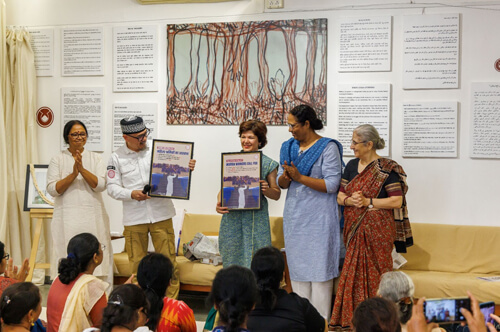
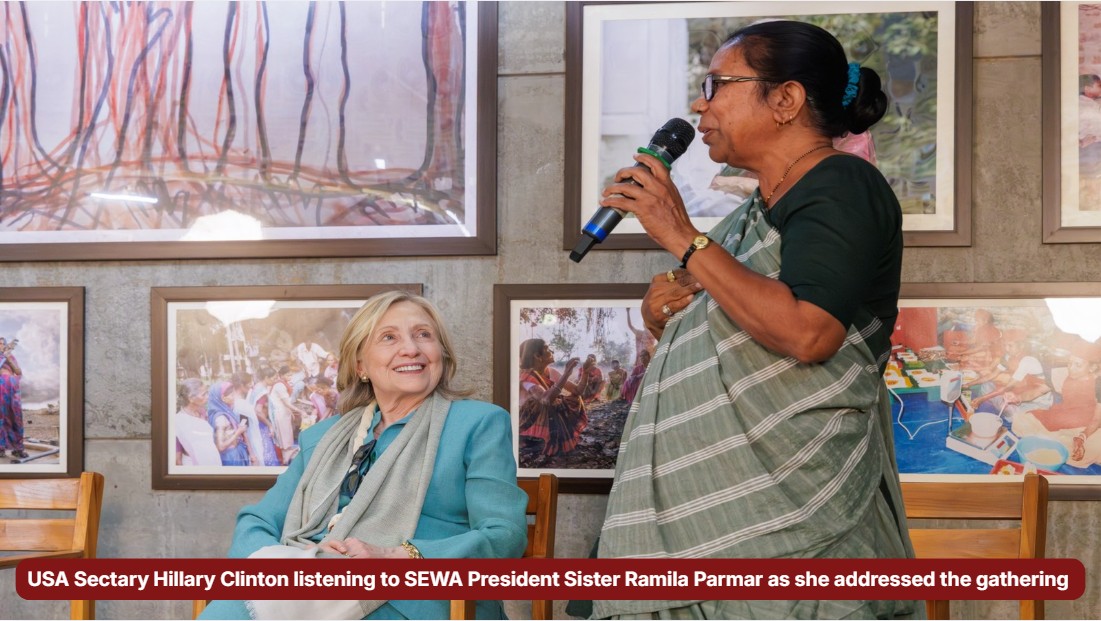
On 20th February, 2026 the women of SEWA welcomed back a friend Hillary Clinton, whom our sisters lovingly call Hillary Ben. Her relationship with SEWA spans more than three decades. She first visited SEWA in 1995 with her daughter, Chelsea Clinton, walking through our spaces alongside Ela Bhatt, listening to the voices of poor self-employed women, farmers, construction workers, waste recyclers, salt workers, and carrying their stories with her across the world. Three years ago, during SEWA’s 50th anniversary celebrations, she returned again, promising that she would come back. On 20th February, she fulfilled that promise.
For SEWA sisters, Hillary Ben is not only a global leader; she is a well-wisher and a steadfast ally in women’s economic empowerment and climate justice. She has consistently affirmed that poor women workers are not victims of poverty, they are solution builders. Over the years, she has stood with SEWA as women build, manage and own their union, institutions, their own bank, cooperatives, enterprises, and social security systems. From 100,000 members during her first visit to 3.8 million today across 20 states of India, she has witnessed what she herself calls the “SEWA effect”, the power of women organizing across generations to transform their lives and economies.
During her address, she reflected on her first visit 31 years ago and said she still carries the stories of SEWA sisters with her. She reaffirmed her belief that SEWA is “the largest association of women in the world” and thanked the members for showing what women can achieve “when we bond together, work together, and lift each other up.” She recalled that three years ago, after meeting salt workers and hearing directly about the harsh impacts of climate change, she announced a partnership to help design the Global Climate Resilience Fund with SEWA. Today, nearly 500,000 SEWA members are among the first workers in the world to be insured against wage loss when temperatures rise above 39°C, a pioneering parametric heat insurance model now drawing global attention. “If we keep working together, if we do not give up, if we do not get discouraged even when the work is hard, we will overcome,” she said.
The gathering also witnessed powerful testimonies from SEWA sisters whose lives reflect both the burden of climate injustice and the strength of collective action. Pinakini ben, a second-generation waste recycler and elected leader, declared with pride, “We are warriors of environment. We keep our cities clean.” She spoke of working from 4 a.m. in open dumping grounds without water or basic facilities, of waste losing value in unseasonal rains, and of rising heat causing dehydration and illness. Yet through SEWA’s climate insurance, she received direct financial support during extreme heat, enabling her to buy groceries and school uniforms. “We earn daily and eat daily,” she reminded the gathering, a simple sentence carrying the weight of economic insecurity and resilience.
Young Mahi, a 13-year-old climate warrior from SEWA’s Knowledge Centre represented the next generation. Under the Green Chali initiative, children are planting trees, growing tulsi and aloe vera, installing sunlit roofs to improve ventilation, and collecting nearly 750 kilograms of plastic every week. With conviction beyond her years, she said that they proudly consider themselves part of SEWA’s Swachh Akash — Building Cleaner Skies — campaign and promised that her generation will “always protect our environment and nurture our nature.”
 Home-based garment worker Fauzia Ben shared how tin-roof houses become “as hot as burning coal” during extreme heat, forcing women to work at night and increasing electricity costs and household tensions. Through SEWA’s collaboration with researchers, including partners from Harvard University, women are now using devices to measure indoor heat, humidity, and health indicators, turning lived experience into evidence for action to plan strategies for climate mitigation actions. “Earlier, I did not know how to use a mobile phone properly,” she said. “Today, I deploy sensors and train other sisters.” Her journey from worker to climate data leader reflects SEWA’s belief that knowledge builds power.
Vegetable vendor Jayshree Ben described how extreme heat dries up produce and sudden rains destroy entire day’s earnings. Financial stress leads to mental stress, affecting whole families. She is also taking trainings to assist members to cope the mental stress in such situations. Yet she spoke with confidence: “We may not have formal degrees, but after joining SEWA, we feel empowered and knowledgeable The strength SEWA has given us is like oxygen for our lives.”
The visit was further enriched by the presence of Joyce Banda, whose connection with SEWA dates back to 1992. She often speaks of the “Ela Bhatt effect” and calls leadership “a love affair, you must fall in love with the people, and the people must fall in love with you.” Inspired by her early exposure to SEWA, she went on to become the first female President in Southern Africa, carrying forward lessons of asset ownership, finance, and women’s collective power to Africa
Throughout the gathering, one message resonated clearly: climate change is pushing poor women back into cycles of debt and vulnerability, yet they are not standing still. From planting over 1.5 million trees, reducing plastic use, and building green villages, to creating India’s first women-owned solar park and pioneering climate insurance, SEWA sisters are not only facing climate change, but they are also leading solutions.
Hillary Ben’s return after 31 years, and again after her 50th anniversary visit, is more than symbolic. It reflects a relationship rooted in shared values, dignity of labour, economic freedom, and collective strength. As SEWA moves toward its next 50 years, preparing to celebrate 100 years of organizing as Ela Ben envisioned, this visit reaffirmed a powerful truth: when grassroots women organize, the world listens.
And as Hillary Ben said to the sisters once again, if we continue to stand together, we will overcome.
On 21st February, the second day of her visit, Hillary Clinton travelled with Joyce Banda to Chaklasi village and later to SEWA’s Shantaghar in Anand, where the focus remained firmly on women’s leadership in the face of climate crisis.
In Chaklasi, the delegation witnessed grassroots innovation in action, from young Poonam ben installing rooftop solar panels to women farmers using solar trap lights, precision pumps, and collectively managing their own cold storage facility. Lalita ben’s words captured the spirit of the day: “All of us are farmers. We love farming, and we believe we will overcome these climate challenges.” Recalling the deadly 2023 heat wave, she said with determination, “From that painful moment, we made a commitment that no woman should ever die because of heat again.”
Jashoda ben shared her transition to finger millet cultivation: “Whether there is heavy rain, unseasonal rain, or very little rain, finger millet survives.” Her voice reflected a larger shift — from vulnerability to resilience.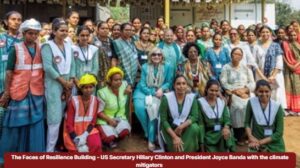
Addressing the gathering, Hillary Ben said she was deeply happy to return. She told the sisters that what they are doing is not small or local, it is global leadership. “You are adapting to climate change in very smart ways,” she said. “You are changing crops, using cold storage, installing solar pumps, you are showing the world how to deal with extreme heat and unseasonal rain.” She added that SEWA is not only helping women cope, but also training them to become leaders and technicians. Reflecting on SEWA’s growth, she said she had seen it expand from 140,000 members to millions today. “You are not just India’s largest women’s organisation, you are the world’s largest women’s organisation.”
Later at Shantaghar, after interacting with African delegates over lunch, hundreds of SEWA sisters gathered once again. Jyotiben, once a tobacco worker, welcomed the leaders and shared about her journey to be the General Secretary of SEWA.
Deepika ben from Bodeli spoke about the devastating 2023 floods. “No one knew when the flood would come. It came at midnight and destroyed everything,” she said. She described how SEWA mobilised relief activities to provide shelter, food, essential items, and loans to rebuild homes. “When everything was destroyed, our union SEWA was there.”
Anjali ben, a climate educator trained for four months, shared that she has installed 71 precision pumps and mobilised 65 women to promote green products. “Earlier, we were never recognised. No one knew about us. Today we are recognised,” she said proudly.
When President Banda addressed the gathering at Shantaghar, her words were deeply personal. President Banda spoke with emotion, recalling her first visit to SEWA in 1992. Now 76, she said she felt blessed to return. She reminded the gathering that leadership is built on love and trust, and she sees that spirit alive in SEWA. Looking at the women, she said she sees champions and future President of India among them.
Addressing the gathering, Hillary ben said that what SEWA is doing is deeply inspiring not only to her but also to people in her country. She recalled the stories she had heard during the visit, especially the 21-year-old solar technician, and said these examples prove that women do not lack talent or determination; they simply need opportunity. “SEWA is not giving charity,” she said. “SEWA is giving opportunity.” She emphasised that through hard work and collective unity, SEWA has grown into the world’s largest women’s organisation and praised the vision behind building such a strong union of informal women workers and thanked them for their leadership in fighting climate change at the grassroots level. She added that the innovations she witnessed, from solar energy to climate adaptation, are lessons the world must learn from. “You are showing how to respond to extreme heat and unseasonal rains with dignity and intelligence,” she told the sisters.
At the end of this event, Ramila ben recalling the vision of Ela Bhatt, organising poor self-employed women for dignity, security, and self-reliance. As voices rose together in “Ame Sangathan karyu Somvaar na re,” the second day reaffirmed what SEWA has always believed: when women organise, they do not wait for change, they lead it.
Returning from her visit to Anand, Hillary ben made a significant stop at the Waste Value Creation Centre (WVCC) in Ahmedabad, an initiative led by SEWA’s women waste recyclers members. The centre stands as a true example of the circular economy and the resilience of women transitioning themselves from vulnerable work conditions to collective ownership of their enterprise. It is an strategic intervention to secure the livelihoods and incomes of the poor waste recyclers that otherwise remain at the bottom of the supply chain. WVCC is a collective initiative that sorts, segregates, bails and sends it to the aggregators for recycling. Meaning, more than 10 tons of waste daily goes less into the dumpsite and that amount of methane gas is emitted less in the environment.
During the visit, Shobha ben a waste recycler leader, welcomed Hillary ben on behalf of all the waste recyclers at the WVCC and shared about the vision behind the centre. Shobha ben a waste recycler leader herself, briefed Hillary ben on their system of operations of WVCC. She said that the waste recyclers without any burden on the Municipal authorities collect waste and contribute to save the environment. Yet they remain invisible, poor and vulnerable. WVCC is the right answer to this issue.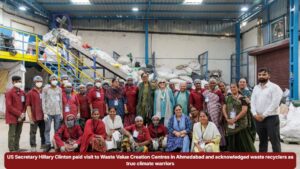
Kesarben, a waste recycler, highlighted that the technology like the conveyor belt, bailing machine, etc used at the WVCC is specifically designed for the women workers with the ‘bottom-up’ approach. “It is easy to adapt and accessible,” she explained, noting that their collective strength allows them to bypass exploitation from scrap traders.
Further Bhartiben, who oversees the mobile collection system across 21 areas of Ahmedabad city, explained about the transition from traditional waste picking to organised waste management system involving more than 700 waste recyclers across the city. She demonstrated the mobile application used by them to ensure transparency and effectivity in this system.
The VCC also focuses on the next generation. Falguni ben, a second-generation waste recycler, now supervises and trains others, proving that the cycle of poverty can be broken through structured capacity building and skilling. She also said that waste is like Gold mines as is the source of livelihood for millions of waste recyclers.
Asha ben, waste recycler sorting at WVCC said that WVCC provides them a cleaner, safer work environment than that at the dumpsites. She added that we are the real climate warriors, we contribute to the climate change mitigation and we deserve the direct benefit of the carbon credits.
Secretary Clinton expressed her deep admiration for the women waste recyclers and emphasised their valuable contribution to the global environment. She shared a hopeful vision that in future SEWA will involve more and more women waste recyclers from dumpsite, start such 3 or 4 more VCC across its membership to bring about dignity of work among these workers.
The visit concluded with a happy note. Alpaben performed a song depicting the life and struggles of a waste recycler. This was a melodic reminder of the journey of waste recyclers from filth to building a future of empowerment and dignity.
The visit of Hillary Clinton and Joyce Banda was not simply a high-level engagement; it was a historic affirmation of SEWA’s grassroots power on the global stage. What made these two days extraordinary was the reversal of the usual narrative, world leaders came not to advise, but to listen. From heat insurance protecting half a million women, to 21-year-old solar technicians climbing rooftops, to flood-affected sisters rebuilding their lives through collective strength, every story reinforced one powerful truth: when poor women organise, they do not wait for solutions, they design them. Hillary Ben’s words, “SEWA is not giving charity, SEWA is giving opportunity,” captured the very soul of SEWA’s philosophy. The visit reaffirmed that dignity of labour, self-reliance, and unity are not just ideals but working models influencing global conversations on climate justice and economic empowerment. For SEWA sisters, this was more than recognition, it was validation that their daily struggles, innovations, and solidarity are shaping the future. The most enduring takeaway is this: grassroots women are not at the margins of change; they are leading it, and the world is finally acknowledging their leadership.