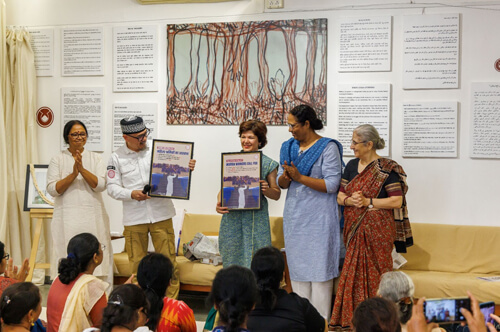
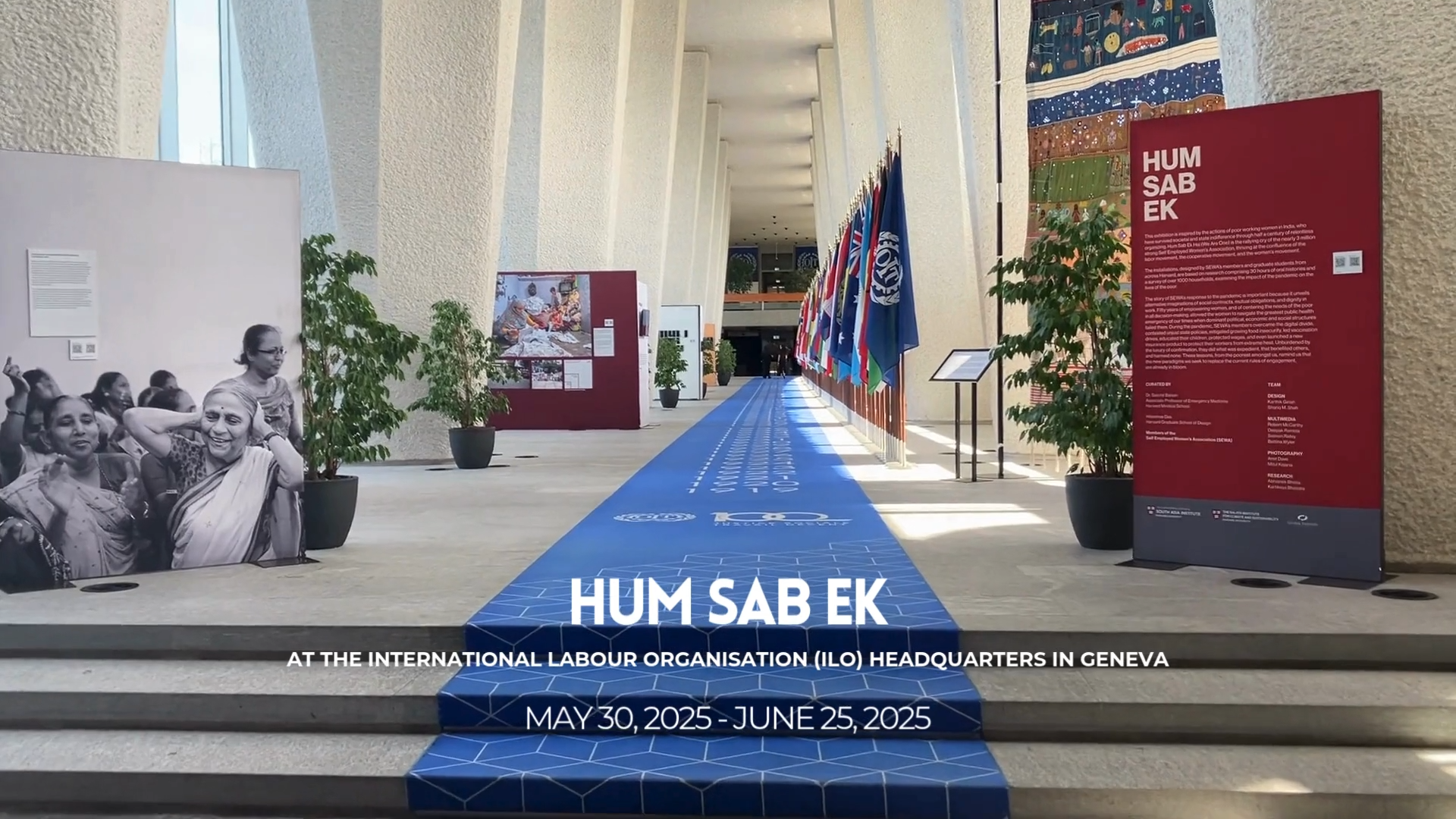
The resilient tale of women workers in the informal economy in India uniting in times of unprecedented global crisis to collectively surmount the tough times of death, disease and loss of livelihood during Covid 19 pandemic reverberated through the Colonnades of International Labour Organization (ILO)’s headquarters, Geneva. The exhibition ‘Hum Sab Ek’ (We Are One) was set up in the main corridor of the ILO building and was inaugurated by Sister Maria Helena Andres, ILO ACTRAV on May 29. Visitors experienced the immersive exhibition till June 25.
The exhibition, designed in partnership with a team from Harvard University, chronicles the life and times of SEWA members through tales of surviving the Covid-19 pandemic.
The multimedia exhibition consists of archival footage of interviews, visualization of the data collected through household survey, and a multi-screen display capturing the importance of digital devices in sustaining health, education, and wages for the women in the informal economy. The title ‘Hum Sab Ek’ (We Are One) reflects the depiction of 3.2 million members of SEWA.
“This could not have been timelier… It is the 10th anniversary of R204, and we will be discussing on formalizing the informal at the 113th Session of International Labour Conference and here we have this exhibition – a tool for education on organizing informal workers, and on sisterhood and solidarity,” said Sister Helena on the occasion of inaugurating the exhibition on May 29, 2025.
Jyoti Macwan, General Secretary, SEWA, remembered SEWA founder Elaben Bhatt and her struggle to ensure international visibility for the informal economy workers from ILO.
“Elaben fought relentlessly for the adoption of Convention 177 for the home-based workers back in 1997,” she said, adding that the voices of SEWA members reverberate in ILO. “This was Elaben’s dream, which has finally come true after 53 years of organizing.”
Catalene Passchier, chair of Workers Group at ILO, also remembered Elaben fondly. “Trade unions of the world are still struggling on the modalities of organizing the informal workers and here we have SEWA who has been showing us the path for over 5 decades. We must learn from them,” she said.
The exhibition was visited by eminent delegates at ILO along with representatives from organizations such as ITUC, IUF, BWI, and IndustriALL among others.
For SEWA members, it is a celebration of dignity of labour and spirit of self-reliance – basic tenets of SEWA’s 50-year journey.
About ‘Hum Sab Ek’ (We Are One)“SEWA- you are making a difference in the lives of millions of women workers in India. You are inspiring and empowering the millions of women around the world. BWI is one with you, in your struggle. Solidarity!”… Brother Ambet Youson, General Secretary, BWI
“I already knew that SEWA has the capacity to overcome extremely challenging situations. But what struck me most by visiting this exhibition is how SEWA is ahead of its time. The pandemic left so many of us hopeless….. but SEWA managed to innovate, maintain and strengthen social intersections, disseminate health knowledge and organise women workers. It is fascinating. Long Life to SEWA !”…. Sister Julie Duchatel, IUF
“Thanks for your dedication to the plight of women workers in India. Your struggles and stories are an inspiration to all of us around the world. In Solidarity”… Sister Christine Campean, CARE
The Covid-19 pandemic posed an existential crisis globally and the workers of the informal economy, in particular the women workers, were the worst impacted. The `Hum Sab Ek’ exhibition brought forward the importance of organised-collective strength of the women workers that emerged as a support system for each other to withstand and build resilience during these tough times. SEWA’s experience of more than 5 decades of organising the women workers of the informal economy and its impact during the pandemic enabled its members to mobilise themselves and respond immediately to the situation collectively.
SEWA partnered with Harvard University to conduct the surveys and key interviews with members from Urban and Rural backgrounds coming from different trades. The study also captured long hours of oral testimonies of the members and this exhibition grew organically from this survey. The story of SEWA’s response to the pandemic is therefore important as it elucidates alternative approaches adopted by the workers of the informal economy to prepare themselves for the intractable challenges that lie ahead.
The result of the study is documented in the form of a multimedia exhibition combining oral history videos, data visualizations and a stunning multi-screen display capturing the salience of digital devices in sustaining health, education and wages.
The exhibition so far has travelled to Harvard University; Clinton Global Initiative, New York; World Bank headquarters, Washington, DC; and Johns Hopkins University, Washington, DC. The oral histories are now part of the Harvard Countway Library’s History of Medicine archives.