SEWA Represents Women Workers of the informal economy at ILC2025 of International Labour Organization, Gets Key Points Added to Adopted Resolutions and Conclusions
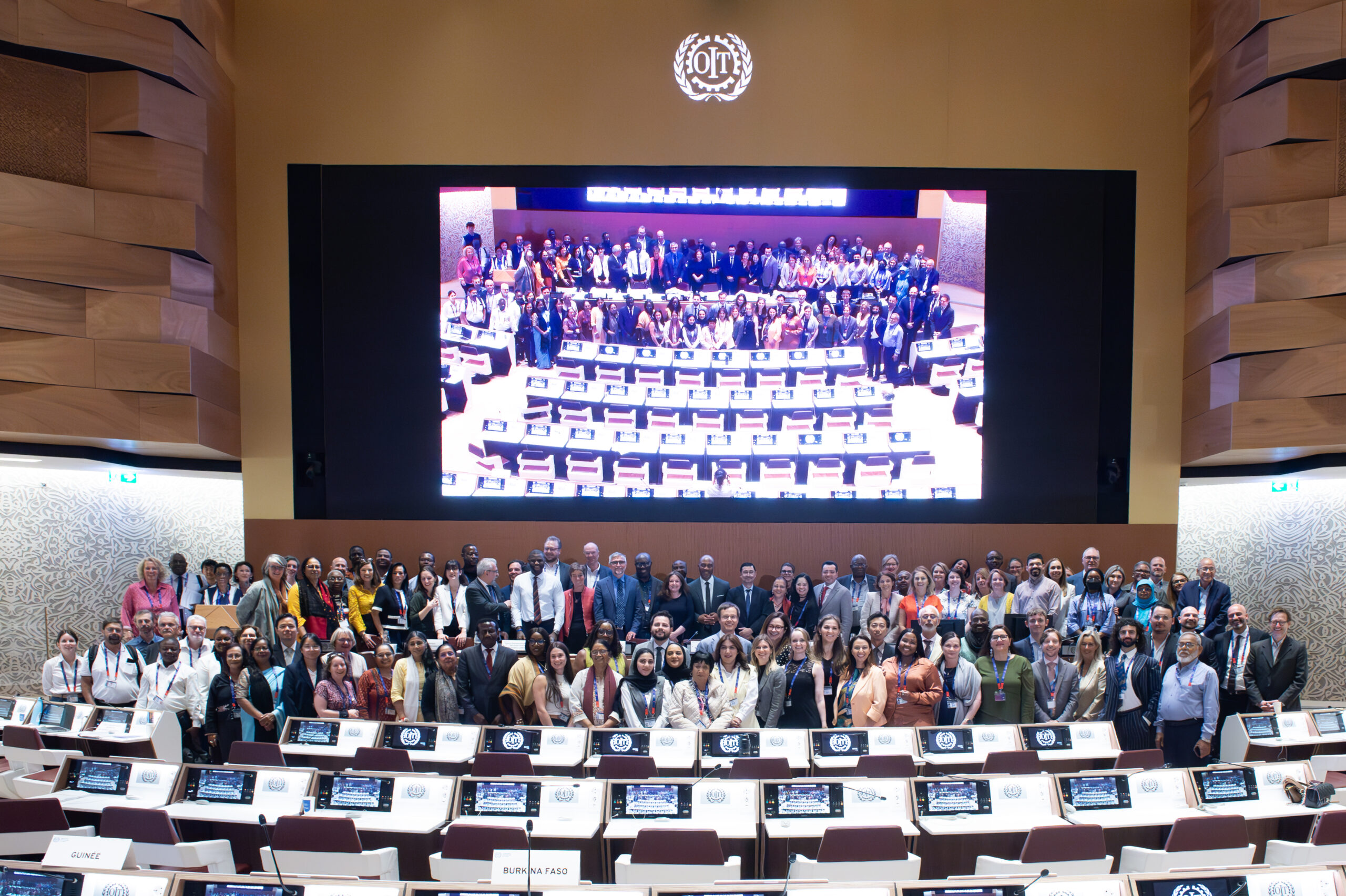
A delegation from the Self-Employed Women’s Association (SEWA) attended the 113th session of the International Labour Conference 2025 at the International Labour Organization (ILO). The Conference was held from June 2 to 13, and was participated by 187 Member States of ILO. This year SEWA was part of the Government delegation to represent in the workers group for the agenda of Informality. We were also part of the drafting group for this agenda.
The Conference agenda included committee for Protection against biological hazards in the working environment and Recommendation for it, secondly committee for standard-setting on Decent work in Platform Economy; and the third agenda was the General Discussion on innovative approaches to tackling informality and promoting transition towards formality to promote decent work.
For the agenda of Informality ILC2025 duly considered the Declaration of Philadelphia (1944) and the ILO Centenary Declaration for the Future of Work (2019) while adopting the Resolutions and Conclusions at the Conference to ask the Governing Body of ILO to give due consideration to it. The adopted Resolutions and Conclusions directs the Director-General to prepare a plan of action for its consideration in the 355th session of the ILO Governing Body due in November 2025.
ILO Recommendation No. 204 (R204) on ‘Transition from the Informal to the Formal Economy’ was adopted in the 104th Session of ILC in June 2015 where the Member States recognized high incidence of the informal economy in all its aspects as a major challenge for the rights of workers, including ‘the fundamental principles and rights at work, and for social protection, decent working conditions, inclusive development and the rule of law, and negative impact on the development of sustainable enterprises, public revenues and governments’ scope of action, particularly with regard to economic, social and environmental policies, the soundness of institutions and fair competition in national and international markets.’
The R204, among other issues mentioned in its Preamble, also acknowledged that most people enter the informal economy not by choice but as consequences of lack of opportunities in informal economy and absence of other means of livelihood.
SEWA is a Central Trade union organizing 3.2 million women workers in 124 trades in the informal economy
Participation of SEWA at ILC was ensure a decadal review and reinforcement of the Recommendation 204. The tripartite committee set up for this agenda was required to adopt Resolutions and Conclusions and highlight key elements for a plan of action for ILO in the informal economy in coming years.
Three important aspects of the general discussion included –
It was important for SEWA to highlight and reinforce the need for recognition for the women workers in informal economy who constantly inhabit the uncertain and precarious work conditions. It was also important to highlight steps taken in areas of labour rights, social security, and decent work for all.
10 years have passed since R204 and in this past decade new concerns have emerged for the informal economy that highlighted during the Conference. Topics like impact of Climate change and artificial intelligence were not addressed in R204. Moreover current perspective in the world of work for these workers in relation with subject of migration, OSH, data dissemination and domestic supply chain were also brought to attention by SEWA here.
Jyoti Macwan, General Secretary, SEWA says “We need to note the absence of explicit provisions on climate change, poverty eradication, and transformative potential of digitalization and Artificial Intelligence in reducing disparities in R204, as important in today’s world of work”
SEWA played a very vital role in the formation of Resolution and Conclusions as we were part of the drafting committee. We provided effective inputs related to the text with the best practice examples for proper draft of this document. SEWA’s experience in the informal economy became base for ensuring opportunities for alternative income security, livelihoods, and entrepreneurship development.
SEWA’s participation at the ILC 2025 can be summarized majorly in the following points that were adopted in the Resolutions and conclusions–
It was one of the new topics included in the Conclusion and Recommendations with SEWA’s efforts where resilience building from all stakeholders was underlined. The participating members agreed that climate change has a near-permanent adverse impact, and need for building resilience for the same.
SEWA advocated a just transition and formalization strategies to increase climate resilience of workers and economic units in the informal economy. SEWA also highlighted the need to promote creation of decent and productive work in environmentally-sustainable economies and to ensure shared prosperity through transition to formality, while improving environmental outcomes.
2. BENEFIT OF SOCIAL SECURITY SCHEMES
Some of the topics of greater concern for SEWA included occupational safety and health (OSH), access to social protection, migration, impact of global and local supply chain, and adverse influence of public-private partnership (PPP) on the work and income security of the women workers. These points were raised well by the delegation. The text in Conclusion and Recommendations asks ILO to provide strategic guidance to enhance assistance to countries. It was to realize the right of all workers to a safe and healthy working environment, following its recent recognition as a fundamental principle and right at work.
Manali Shah, National Secretary, SEWA says “There needs to be budget allocation for workers centric and trade specific social security for the informal workers at national level. In our experience, we have Social Security Act, but no budget allocation for the schemes in it. Thus, it is important to include this point in the Resolutions and conclusions.”
3. INCLUSION OF NON-AGRICULTURE RURAL WORKERS AND THE RECYCLING WORKERS IN THE TEXT.The Draft Conclusions submitted by the office mentioned different trades of the informal economy like the home-based workers, street vendors, construction workers, agriculture workers, migrant workers but did not recognize the gamut of rural workers a– it only recognized agricultural workers. SEWA emphasized that the text must include all rural workers. Reason behind the move is cyclic nature and complex vocation patterns seen in rural areas.
The workers often get employment in the agriculture sector for 6-8 months a year. For the rest of the period, they are involved in other economic activities like cattle rearing, animal husbandry, craft and artisanal work, working in saltpans, etc.
Moreover, SEWA also successfully integrated recycling workers along with waste pickers who were on the list, to ensure inclusion of the downstream shipbreaking workers. Reason for the move was its very important role in circular economy based on SEWA’s experience of working with them. These recycling workers often work on a wide range of materials ranging from anchor ropes to e-waste generated by ships arriving for dismantling.
4. RECOGNIZING TRANSITION AS A GRADUAL PROCESSThe Conclusions also recognizes that transition towards formality is a complex and gradual process that should keep in mind the demands of informal economy workers. Thus, there must be reforms in policies, laws, and regulations that prevents formalization.
In SEWA’s experience, if a street vendor gets an Identity card then that is the first step of formalization process.
5. TECHNOLOGICAL INNOVATIONOne of the drivers towards informality, as pointed out by SEWA and included in the Conclusions is the technological innovation and the inability of the informal economy workers to withstand it. We argued that this point is important because these changes have top-to-bottom approach and under no circumstances, they elevate the working conditions of the workers.
It is important primarily to ensure that the workers get recognition and in turn benefits of government schemes ranging from PM Swanidhi Yojana to Kisan Rural Yojana/ PM Kisan Nidhi to the small and marginal farmers for their development.
6. USE OF ILO DATA FOR POLICYMAKINGAnother major input from SEWA delegation was to ensure that the data collected and analyzed by ILO should be translated into formulation of relevant policies and address its implementation gaps at the country level. SEWA highlighted that data collection and dissemination does not percolate down from national level to regional or city level that can help workers. Such data must be used for improving delivery of social service and protection schemes. It should also be translated into program support and worker economy.
The conclusions clearly point out on developing and strengthening the research and analytical capacities of the ILO to facilitate evidence-based policymaking, to inform the design, implementation, monitoring, and evaluation of formalization policies that are responsive to the diversity of contexts and circumstances and that leave no one behind.
Resolution and Conclusion also asks the office to share best practices along with promoting peer-to-peer learning and knowledge-sharing.
7. GENDER-RESPONSIVE MEASURESFor a collective voice and policy intervention, SEWA recommended gender responsive measures and inclusive policies with evidence-based policy coherence and stronger monitoring mechanisms. It was to assess progress towards formality to ensure regulation and growth of decent work for workers of the informal economy, in particular women workers.
This was well integrated in the document to ensure effective implementation of R204. The Conclusions also encourages the worker-led social solidarity economic units by recognizing the need for enabling environment for them.
8. ESTABLISHING A DAY TO CELEBRATE INFORMAL ECONOMY WORKERSIn November 2023, the IUF – International Union of Food, Agricultural, Hotel, Restaurant, Catering, Tobacco, and Allied Workers’ Associations representing more than 10 million workers – adopted November 2 as International Day for Informal Sector. It was to honour Elaben Bhatt’s death anniversary and legacy of SEWA in the field of women empowerment.
The Conclusions acknowledges the possibility to introduce a specific day to give visibility to the challenges faced by all the workers in the informal economy when SEWA intervened and presented the need to mark a day for the women workers of the informal economy. SEWA suggested the same day for recognition of Elaben’s role in founding the biggest trade union for the women workers of the informal economy and pioneering role to bring visibility to these workers during six decades of her active public life.
This was strongly supported by IUF and all the members of workers group.
The delegation members of SEWA participated actively in the discussions, delivered the speeches, and voiced their opinions during the plenary sessions and other platforms. SEWA was among the only three trade unions to address the closing plenary sessions when the Conclusions and Resolutions were adopted. SEWA will take forward the resolutions made and also help in transition process for the points raised.